Second Lives: Asia’s Hotels in Old Offices, Mills, Lane Houses and Palaces
A government tower in Hong Kong, a telephone exchange in Kyoto, a sugar mill on the Li River, Shanghai lane houses, Beijing hutongs, a Dutch headquarters in Galle and a palace on Lake Pichola: how Asia's best conversions give old buildings a second life as hotels.
Asia builds new hotels faster than anywhere else, and most of them are towers. Against that background, a growing group of hotels has taken the opposite route and moved into buildings made for something else. They are harder to build, often smaller and always constrained by what survives, but they give a city something a new tower cannot: continuity. The best examples covered by OKYTO fall into three families.
Civic and industrial buildings
The boldest conversions take buildings with no domestic past. In Hong Kong, the Murray Building, a 1969 government office tower designed for a city planned around the car, was rezoned in 2010 as a building of architectural merit to be preserved for hotel use; Foster + Partners kept its sun-angled windows and turned it round at street level to make The Murray. In Kyoto, Ace Hotel Kyoto occupies Tetsuro Yoshida’s 1926 Central Telephone Office, the first building Kyoto listed when it began protecting its own cultural properties, restored by Kengo Kuma’s office within a larger new block; OKYTO’s Kyoto architecture through its hotels places it among the city’s other design hotels. On the Li River near Yangshuo, Vector Architects turned an abandoned 1960s sugar mill into a hotel, keeping the mill at the centre and building around it in concrete cast in wooden formwork. And in Shanghai, Bvlgari joined a new tower to the 1916 building of the Shanghai General Chamber of Commerce, entered through a gate modelled on a Roman triumphal arch.
The urban fabric
A second family has taken over ordinary houses and the lanes between them. Capella Shanghai runs 55 villas in Jian Ye Li, a 1930s estate of shikumen lane houses in the former French Concession. In Beijing, Mandarin Oriental Qianmen has no main building at all: its 42 rooms are restored courtyard houses scattered through the Caochang hutongs, whose lane pattern has barely changed since the eighteenth century. The Temple House in Chengdu is entered through a restored Qing courtyard house. In George Town, Soori Penang has turned shophouses of the Khoo Kongsi compound into fifteen suites, and on an island of the Seto Inland Sea, Azumi Setoda was made from a salt merchant’s house of 1876, with a public bath for the town opposite.
Palaces, forts and headquarters
The oldest family is the conversion of buildings of power, a habit that began long before the term adaptive reuse. Taj Lake Palace, an eighteenth-century summer palace on an island in Lake Pichola in Rajasthan, has been a hotel since 1963. Nearby, Six Senses Fort Barwara took more than a decade to restore a fourteenth-century fort. In Galle, Amangalla occupies a seventeenth-century Dutch headquarters that has been a hotel since 1866. And in Nara, Kengo Kuma built Shisui around a governor’s residence of 1922 and its garden.
What makes a conversion work
The successful examples share three things. They keep enough of the original to be legible, even when, as at Jian Ye Li, much of the fabric had to be rebuilt. They let the old building organise the guest’s experience, as at the Temple House, where the arrival runs through the Qing house before anything new appears. And they return something to the city: the street frontage of The Murray, the bath at Setoda, the public lanes of Qianmen. For a wider view of how old hotels survive, see OKYTO’s Asia’s grand old hotels and old towns of the trade routes.
Mentioned
In this story
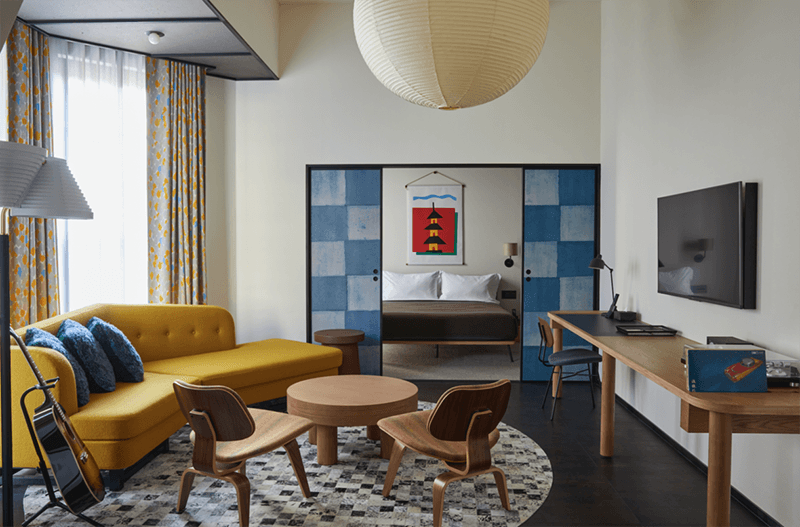 Kyoto · Ace HotelAce Hotel KyotoAce's first hotel in Asia moved into the 1926 telephone exchange that Kyoto listed before any other building.Discover →YangshuoYangshuo Sugar HouseVector Architects' rebuilt 1960s sugar mill on the Li River opened as Alila Yangshuo in 2017.Discover →
 Shanghai · Bvlgari Hotels & ResortsBvlgari Hotel ShanghaiBvlgari Hotel Shanghai joins a tower on Suzhou Creek to the restored Shanghai General Chamber of Commerce.Discover →