The Peninsula Hong Kong: The Story of the Grande Dame
Opened in 1928 where the ocean liners docked and the trains left for Europe, the hotel in Tsim Sha Tsui has kept its lobby, its afternoon tea and its green Rolls-Royces through nearly a century.
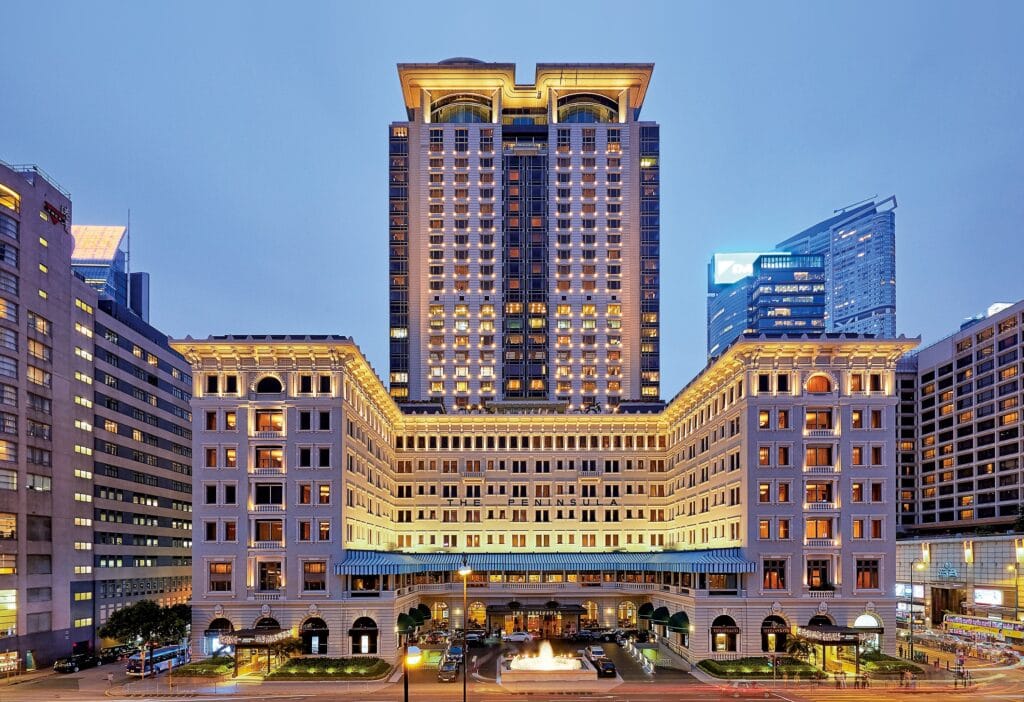
The Peninsula opened on 11 December 1928 at the tip of Kowloon, facing the harbour and Hong Kong Island. It is the oldest hotel in the city still in business and the first of the group that bears its name. It is still owned by the company the Kadoorie family controls, which is rare among the great hotels of the world.
The finest hotel east of Suez
The site was chosen for its position. The quays where the ocean liners tied up were a few minutes away. So was the terminus of the Kowloon-Canton Railway, whose clock tower still stands on the waterfront, from which a passenger could travel by way of Siberia to Europe. The hotel was built to receive these travellers, and its owners, the Hongkong and Shanghai Hotels company, announced it as the finest hotel east of Suez. The building was a seven-storey block in an H shape with a forecourt and a fountain, and a lobby of tall columns and gilded plasterwork.
It quickly became the centre of social life in the colony, with tea dances, a roof garden and a ballroom. On Christmas Day 1941, after the battle for Hong Kong, the British governor signed the surrender to the Japanese forces in a room on the third floor. During the occupation the hotel was used as a headquarters and renamed the Toa. It was returned to its owners in 1945.
The restaurants
In 1953 the hotel opened Gaddi’s, a French restaurant named after a former general manager, which was for decades the grandest dining room in Hong Kong and still serves under its original chandeliers. Spring Moon, the Cantonese restaurant, opened in 1986 in the style of a 1920s teahouse, and has a claim to have invented XO sauce.
Afternoon tea in The Lobby is the best-known ritual. It is served from two in the afternoon, to the sound of a string ensemble on the balcony, and tables are not reserved, so there is usually a queue.
The tower and the cars
By the 1990s new towers had risen all round. In 1994 the hotel added one of its own, thirty storeys high, behind the original building, which kept its facade. The tower brought the number of rooms to 300 and included a roof with twin helipads, used for transfers and flights round the harbour. At its top the hotel opened Felix, a restaurant and bar designed by Philippe Starck.
The hotel has kept a fleet of Rolls-Royces since 1970. In 2006 it ordered fourteen Phantoms, the largest single order the maker had received, painted in a dark shade known as Peninsula green. They carry guests to and from the airport. The page boys in white uniforms and pillbox caps who open the doors are as much a part of the image.
The rooms were last rebuilt in 2012 and 2013, at a cost of HK$450 million, with a system of bedside tablets developed by the hotel’s own engineers.
Its place today
Tsim Sha Tsui has changed around it. The railway terminus went in the 1970s. In its place, and along the shore, there are now the Cultural Centre, the Museum of Art, K11 Musea and Rosewood Hong Kong, which has been named the best hotel in the world. The Peninsula now has sister hotels in Asia, Europe and North America, among them Tokyo and Shanghai, and in 2024 the owning company appointed a new chief executive. The original remains the reference for all of them.
Continue
More from Hong Kong
 Hong KongA vertical city of harbour views and mountain trails, with Cantonese dining and some of Asia's finest hotels.Read →
 News · Food & DrinkThe Chairman Reclaims No.1 in Asia’s 50 Best Restaurants 2026Danny Yip's Cantonese restaurant returned to the top of the ranking on 26 March 2026.March 26, 2026Read →
 News · Food & DrinkBar Leone Named The World’s Best Bar 2025Lorenzo Antinori's Roman-style neighbourhood bar on Bridges Street became the first Asian bar to lead…October 8, 2025Read →
 News · TravelMandarin Oriental, Hong Kong Plans US$100 Million RenovationA phased renovation brings new interiors, residences and dining to the Hong Kong flagship.April 22, 2025Read →