The Peninsula Shanghai
A 2009 building on the Bund, made to speak the language of its historic neighbours by the company that ran the Astor House between the wars.
- Neighbourhood
- The Bund, Huangpu
- Status
- Open
- Design
- David Beer (BBG/Architects); interiors by Pierre-Yves Rochon
No. 32 The Bund stands at the northern end of the waterfront, where Suzhou Creek runs into the Huangpu beside the lawns of the former British Consulate. The Peninsula Shanghai opened there in October 2009, with 235 rooms, none smaller than 54 square metres. Its owners described it as the first new building on the Bund in more than sixty years.
The building is new; the company behind it is not. The Hongkong and Shanghai Hotels took its present name in 1923, after a merger with the company that owned the Astor House, and only in 1928 opened The Peninsula in Hong Kong. The new hotel exists because that company wanted to come back.
The company that left
Between the wars the group ran four hotels in the city: the Astor House, the Palace, the Majestic and the Kalee. The Kadoorie family, its leading shareholders, lived in Shanghai, and Sir Elly Kadoorie died there in 1944, during the Japanese occupation. After the war the company's position in the city unravelled, and in 1954 the Astor House was confiscated.
Two of those hotels still stand within a short walk of the new one. The Astor House is just across the Garden Bridge, on the north bank of Suzhou Creek. It traded for decades as the Pujiang Hotel and has been the China Securities Museum since 2018. The Palace, at the corner of Nanjing Road, is now the Swatch Art Peace Hotel. The Peninsula's terraced signature suites are named Astor, Majestic and Palace. Sir Elly's, the rooftop restaurant, carries the name of the grandfather of the group's chairman, Sir Michael Kadoorie.

Art Deco by intention
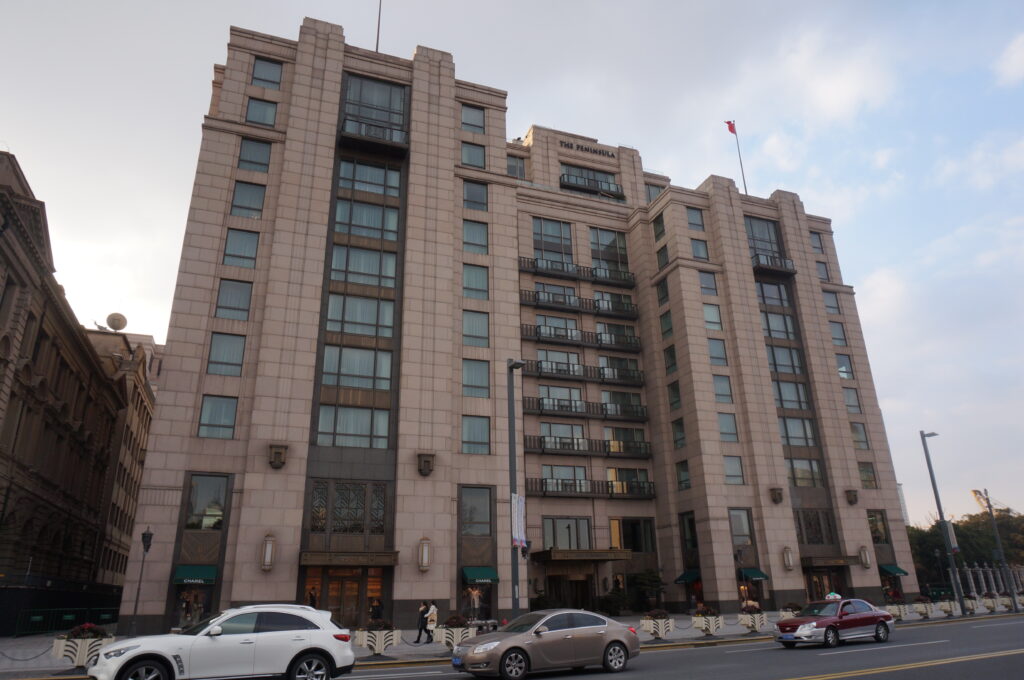
The Bund's great buildings are banks, clubs and trading houses of the 1900s to 1930s, and its most famous hotel for history, the Peace Hotel, occupies one of them. The Peninsula had no original to restore. Its architect, David Beer, then of BBG/Architects, designed a building that defers to its neighbours. The Bund façade rises ten storeys in granite from the same quarry as many of the historic buildings along the river, then steps back through a series of terraces, so that from the promenade the new building holds the old line.
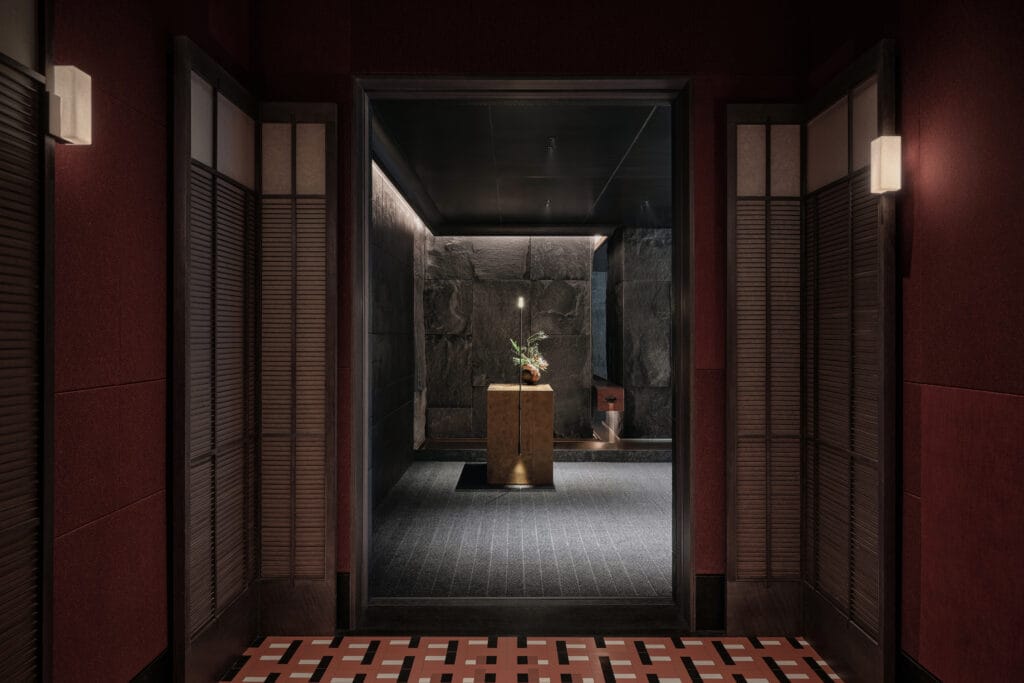
Inside, Pierre-Yves Rochon set a modern reading of Art Deco against discreet Chinese references, and Henry Leung designed the lobby and restaurants. At the opening, the lobby was a double-height room with black marble floors, limestone walls and a backlit carved-glass ceiling, with a minstrels' gallery above. The rooms were furnished at opening in mahogany and ebony with black Saint Laurent marble, materials chosen to recall 1920s Shanghai, and the hotel still describes its Deluxe Terrace Rooms in those terms.
This is heritage by intention rather than by inheritance. A guest who wants to sleep inside one of the Bund's original buildings should choose the Peace Hotel. A guest who wants the Bund outside the window and a building planned for modern hotel life within it is better served here.
Kowloon habits on the Bund
What The Peninsula brought from Hong Kong is less a style than a set of habits. Four extended-wheelbase Rolls-Royce Phantoms wait at the door. Afternoon tea is served in the lobby, as it is at the 1928 hotel in Kowloon. Between the basement and the second floor runs a lift that Schindler built as a replica of a 1930s original in the Belgian Lift Museum in Brussels. On the 14th floor, a glass-enclosed lounge is given over to the history of aviation in China, around a life-size replica of a vintage aircraft. The hotel keeps a yacht for the river.
Both main restaurants look back to the city's past. Yi Long Court, on the second floor, is laid out as the house of a 1930s merchant, with private dining rooms off the main room, but the cooking is Cantonese. Sir Elly's, on the 13th floor, opened as a European dining room and now serves Northern Italian cooking. Its terrace looks south along the curve of the Bund's granite frontages, and across the river to the towers of Pudong. There is also TAKIYA SHANGHAI, the first overseas branch of a Tokyo tempura counter, and the Compass Bar. The spa, over 1,250 square metres, has an indoor heated pool opening onto an outdoor terrace.
Three ways to face the city
The hotel sorts its rooms by what they face. The River rooms look east across the Huangpu to Pudong. The Garden rooms look north over the trees beside the hotel towards the Garden Bridge and Suzhou Creek. The plain Deluxe rooms face the city. The Executive Suites sit on the corners with windows on two sides, over the gardens and the bridge. The rooms were planned at opening in three parts, bedroom, bathroom and dressing room, closed off from one another by a privacy door, which brings even the standard rooms closer to small suites.
The suites make the most of the building's stepped profile. The Astor Suite has a terrace of 115 square metres with a whirlpool over the Bund. The Majestic Suite has a two-storey living room. The largest, the Palace Suite, has a wraparound terrace of 1,098 square metres, which the hotel describes as the largest private terrace on the Bund. Across the creek, a few hundred metres away, stands the Astor House, the hotel the company lost in 1954.
Sources: The Peninsula Shanghai; The Peninsula Shanghai; HSH; Hospitality Design; Historic Shanghai; Historic Hotels of America; MICHELIN Guide.
Location
- Address
- 32 Zhongshan Dong Yi Road, The Bund, Shanghai
- Website
- Official website