Gyeongju: Two Days in the Old Capital of Silla
For almost a thousand years Gyeongju was the capital of a Korean kingdom. Its grass-covered royal tombs, its stone observatory and its mountain temple make it the best place in the country to see the ancient past.
Gyeongju lies in the south-east of the Korean peninsula, in a basin among low mountains. From 57 BC, by the traditional reckoning, until 935 it was the capital of Silla, the kingdom that united most of the peninsula in the seventh century. At its height it was one of the largest cities in the world. It has been called a museum without walls, and three groups of its monuments are on the World Heritage list.
Day one: the city of tombs
The centre of Gyeongju is full of grassy hills, some more than twenty metres high. They are the tombs of the Silla kings and nobles. Each is a wooden chamber covered with a mound of river stones and then with earth, which made them almost impossible to rob.
Daereungwon. A walled park that holds 23 of the great mounds. One of them, Cheonmachong, the tomb of the heavenly horse, was excavated in 1973 and can be entered. It shows how the chamber was built and what it contained, including a gold crown and a painting of a white horse on birch bark.
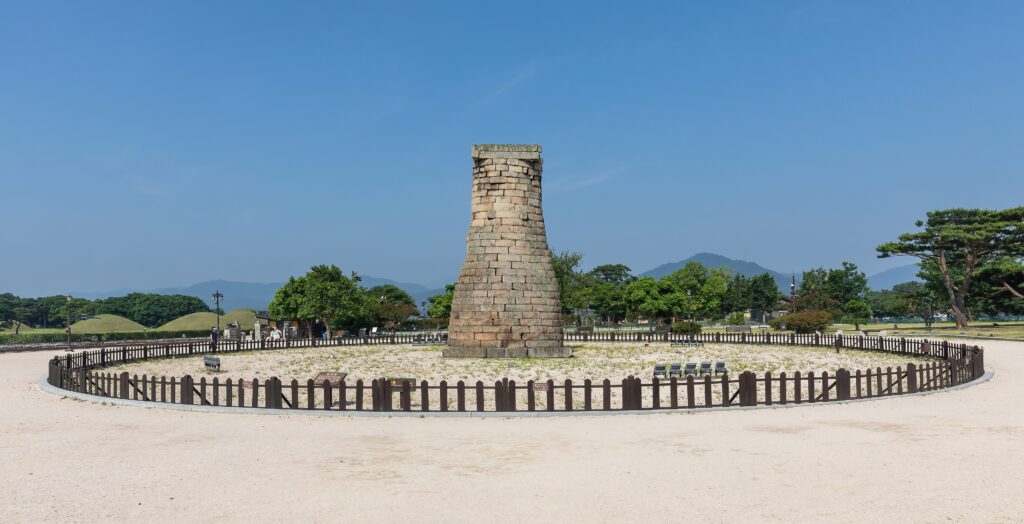
Cheomseongdae. A bottle-shaped tower of granite blocks nine metres high, built in the seventh century, a few minutes’ walk from the tombs. It is one of the oldest astronomical observatories in East Asia.
The national museum. The gold crowns, belts and earrings taken from the tombs are here, with tall crowns shaped like branching trees and hung with jade. In the garden hangs the Emille Bell, cast in 771, more than three metres high, whose note is said to carry for miles.
Donggung and Wolji. The pond of a Silla pleasure palace, with rebuilt pavilions on its banks, is at its best after dark, when the buildings are lit and reflected in the water.
In the evening, the lanes of Hwangnidan-gil, beside the tomb park, have several hundred cafés, restaurants and shops in traditional tiled houses.
Day two: the mountain
Bulguksa. The temple, on the slope of Mount Toham, sixteen kilometres from the centre, was built in the eighth century. Its stone terraces, stairways and two pagodas are original. The wooden halls were rebuilt after their destruction in the sixteenth century.
Seokguram. Higher up the same mountain, a domed chamber of granite was constructed in the same period to hold a seated Buddha three and a half metres high, facing the East Sea and the sunrise. It is among the finest works of Buddhist sculpture in Asia. Visitors see it through glass. The walk between the temple and the grotto, through forest, takes about an hour.
Travellers with a third day can walk on Namsan, the hill south of the city, where rock-cut Buddhas and ruined pagodas are scattered along the paths, or visit Yangdong, a village of the Joseon period that is still inhabited.
Practical advice
The KTX from Seoul takes about two hours to Gyeongju’s high-speed station, which is twenty minutes from the centre by bus or taxi. Busan is half an hour away by the same line. The centre is flat and bicycles are the best way to move between the tombs, the observatory and the pond. The cherry blossom of early April and the autumn colour of late October are the best seasons.
Gyeongju was the host of the APEC summit in 2025, which brought new hotels and restored sites. A small design hotel here is among three Korean properties that joined Design Hotels. Several temples in the district take guests overnight under the programme described in our guide to temple stays in Korea. Within an hour are two more recent World Heritage sites, the whale carvings of Ulsan and the Gaya burial mounds.