Singapore’s Hawker Culture Joins UNESCO’s Intangible Heritage List
UNESCO inscribed hawker culture on 16 December 2020, Singapore's first entry on the list. The city's open-air food centres were described as community dining rooms shared by people of every background.
UNESCO inscribed hawker culture in Singapore on its Representative List of the Intangible Cultural Heritage of Humanity on 16 December 2020. It was Singapore’s first entry on the list. The organisation described the city’s hawker centres as community dining rooms, where people from different backgrounds gather and share the experience of eating breakfast, lunch and dinner.
From the street to the centre
Hawkers were once street sellers. Migrants from southern China, India and the Malay world cooked the food of their home regions on the pavements and quays of the colonial port, each selling one or two dishes. From the 1960s the government moved them off the streets, for reasons of hygiene and traffic, into purpose-built covered markets with running water, drains and fixed tables. The street trade disappeared and the hawker centre took its place.
There are now more than 110 such centres, most of them run by the National Environment Agency and attached to public housing estates. A centre holds anything from thirty to more than two hundred stalls. Each stall is still, as a rule, the business of one cook or one family making a narrow range of dishes: chicken rice, char kway teow, laksa, satay, roti prata, fish-ball noodles, carrot cake that contains no carrot. Prices are a few dollars a plate.
What UNESCO recognised
The inscription is for the culture as a whole and not for any dish. It covers the cooks and their skills, the mixing of Chinese, Malay, Indian and other cuisines in one room, and the habit, common to rich and poor, of eating out at shared tables every day.
It also carries a warning. Many hawkers are old. The work is hot, the hours are long and the margins are small, and their children often choose other careers. Singapore has set up training and apprenticeship schemes to bring in new cooks, and some younger hawkers have opened stalls with new ideas. The question of who will be cooking in twenty years remains open.
For travellers
A visitor should eat at a hawker centre at least once a day. The best-known in the centre of the city are Maxwell, in Chinatown, the Victorian cast-iron market of Lau Pa Sat in the financial district, Tiong Bahru, above a wet market, and Old Airport Road. The routine is simple. Find a seat first and mark it, traditionally with a packet of tissues. Queue at the stall, pay in cash or by card, and carry the food back. Trays must be returned afterwards, by law. The longest queue is usually a reliable guide.
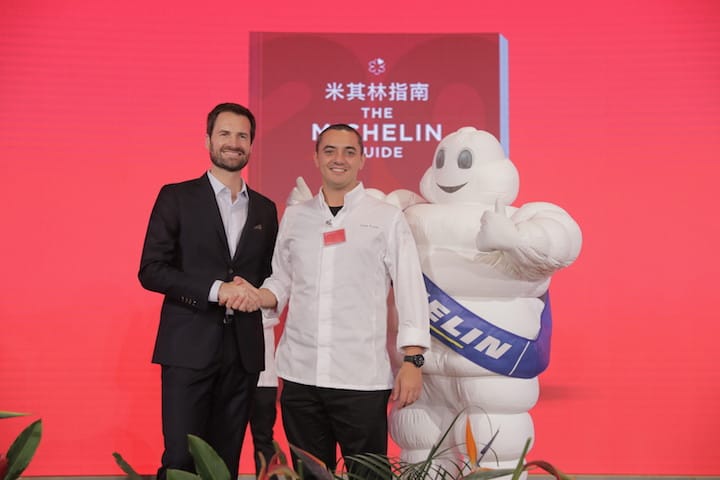
Hawker food was first honoured by another institution in 2016, when Michelin gave stars to two stalls in its first Singapore guide. The 2026 edition still lists dozens of hawkers in its Bib Gourmand selection.
Continue
More from Singapore
 SingaporeSingaporeA compact city-state of gardens, hawker food, leading restaurants and landmark hotels.Read →
 News · Design & ArchitecturePan Pacific Orchard Opens in SingaporeWOHA's 23-storey tower off Orchard Road stacks four open-air terraces of forest, beach.June 5, 2023Read →
 News · Food & DrinkOdette and Les Amis Win Three Michelin StarsThe 2019 Singapore selection gave the city two three-star restaurants for the first time.September 17, 2019Read →
 News · Design & ArchitectureJewel Changi Airport Sets 17 April OpeningMoshe Safdie's glass-domed complex at Singapore's airport, built around a 40-metre indoor waterfall.March 7, 2019Read →