Visiting the Mogao Caves: A Thousand Years of Buddhist Painting at Dunhuang
Some 735 caves cut into a cliff at the edge of the Gobi hold the largest body of Buddhist wall painting in the world. Visits are tightly managed. How the system works and how to see more.
Dunhuang is an oasis in the far west of Gansu province, where the Silk Road divided to pass north and south of the Taklamakan desert. Twenty-five kilometres south-east of the town, a cliff above a dry river bed is pierced by hundreds of caves. They were cut and painted by Buddhists over a thousand years, and they have been a World Heritage site since 1987.
The caves
By tradition the first cave was dug in 366 by a monk named Le Zun, who had a vision of a thousand Buddhas in the evening light on the cliff. Others followed him. Merchants, officials and ruling families paid for new caves as acts of merit, to secure a safe crossing of the desert or the welfare of their ancestors. Work went on until the fourteenth century and was at its height under the Tang dynasty.
About 735 caves survive. Nearly five hundred are decorated, with some 45,000 square metres of wall painting and more than 2,000 painted clay figures. The styles change from cave to cave, from the Indian and Central Asian manner of the early centuries to the full, confident painting of the Tang, with its paradise scenes, flying apsaras, musicians and portraits of donors in the dress of their day. Two caves hold colossal seated Buddhas, the larger about 35 metres high, behind the nine-storey wooden facade that is the emblem of the site.
The Library Cave
In 1900 a Daoist priest, Wang Yuanlu, who had made himself guardian of the caves, found a walled-up chamber off one of the corridors. It contained about 50,000 manuscripts, paintings and textiles, sealed since the eleventh century. Among them was a copy of the Diamond Sutra printed in 868, the oldest dated printed book in the world. Within a few years most of the contents had been sold to foreign expeditions, and they are now divided between London, Paris, St Petersburg, Delhi, Beijing and other cities. An international project has been reuniting them in digital form.
How a visit works
The paintings are fragile, and breath and humidity damage them. The Dunhuang Academy, which has cared for the site since the 1940s, limits the number of visitors each day and controls how they see it.
The visit begins at a digital centre near the town, opened in 2014, where two films are shown, one of them on a dome screen that reproduces the interiors of caves in detail. Shuttle buses then take visitors to the cliff. There a guide from the academy leads each group into a set of caves, usually eight, chosen from those open that day. They include the Library Cave and the great Buddhas. The caves are unlit, and the guide uses a torch. Photography is forbidden inside.
Tickets sell out in summer and at holidays. How far ahead they are released, the number of caves shown and the prices change, so check the Dunhuang Academy’s official booking site before you plan. English-language tours run at fixed times. For those who want to see more, the academy opens certain special caves for an additional fee per cave, booked on the spot. It is the best way to see early caves and fine Tang work that the standard route omits.
Practical advice
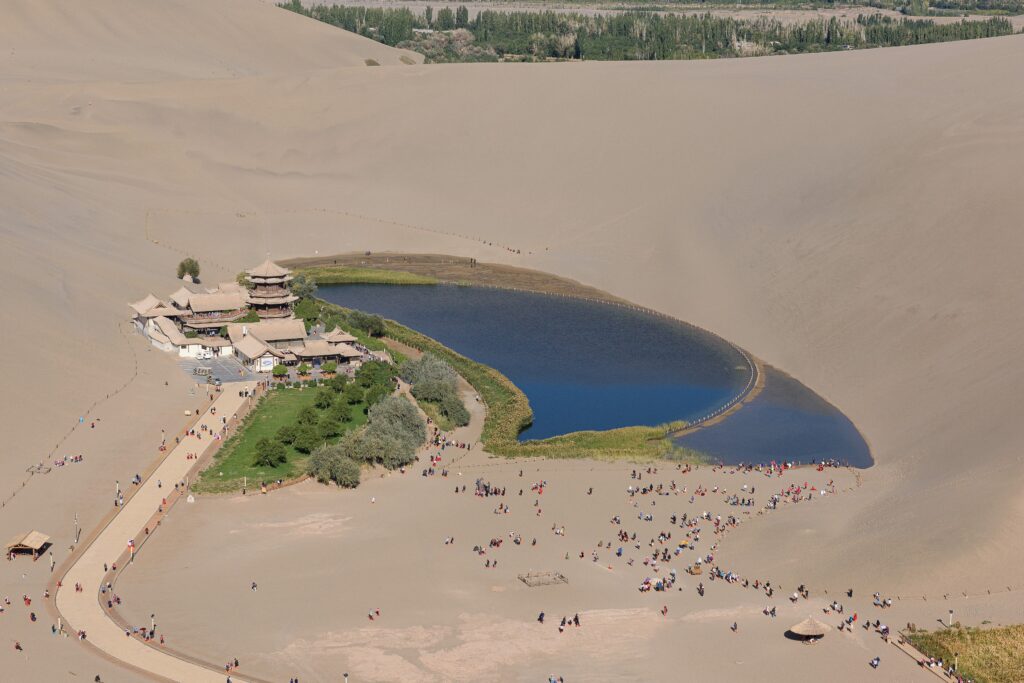
Dunhuang has an airport with flights from Xi’an, Lanzhou and Beijing, and a railway station. May, September and October are the best months. July and August are hot and crowded. Allow half a day for the caves and book the earliest slot. The same town is the base for the dunes of Mingsha and the Crescent Lake, and for the ruined forts and beacon towers of the Han frontier.
Travellers with more time can continue east along the Hexi corridor to Zhangye and the lakes of the Badain Jaran Desert, or to the Xixia imperial tombs near Yinchuan. Our guide to China’s most distinctive places to stay covers hotels in the less visited provinces.