Dunhuang Beyond the Caves: Singing Dunes, a Crescent Lake and the Han Frontier
Most visitors come to Dunhuang for the Mogao Caves and leave the next day. The dunes at the edge of town and the ruined passes of the Han frontier are reasons to stay two more.
Dunhuang is known for the Mogao Caves, and the caves deserve their fame. But the oasis was important long before the first cave was cut, as the last Chinese town on the road to the west. The desert around it holds the evidence: the gates through which the caravans passed, and the dunes they had to skirt.
The oasis
Dunhuang lies in the north-west of Gansu at about 1,100 metres. It was one of the frontier garrison towns established by Emperor Wu of the Han after the defeat of the Xiongnu, around 111 BC. Its name means “Blazing Beacon”, after the signal fires of the frontier. Under the Sui and Tang dynasties it was the main point of contact between China and the countries beyond.
The climate is that of a cool desert, with very little rain and a great deal of sunshine.
Mingsha and the Crescent Lake
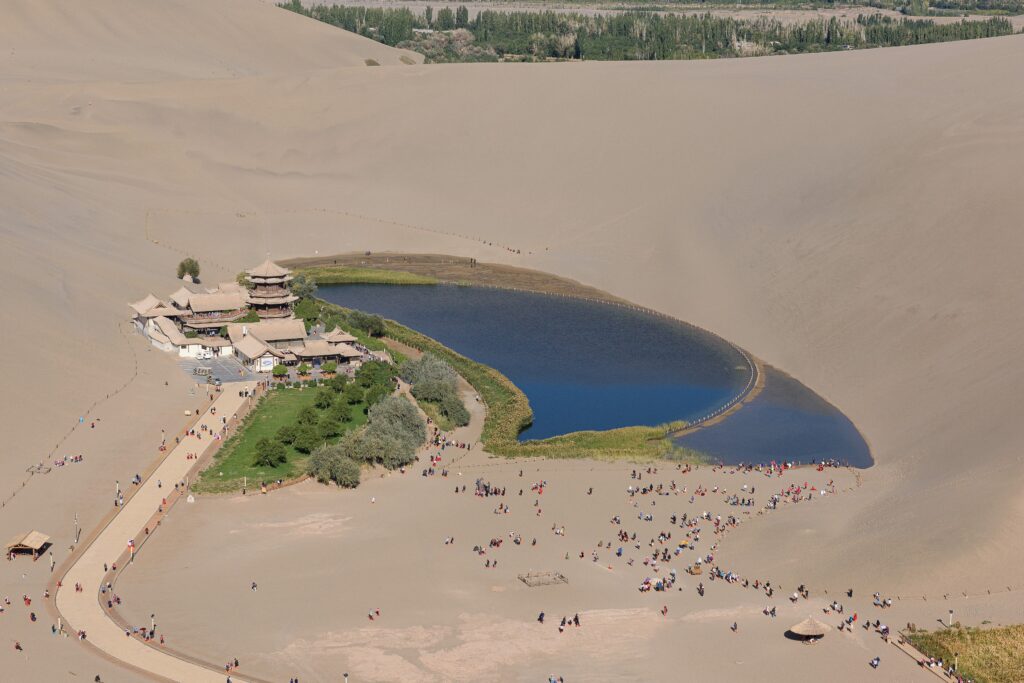
The Mingsha dunes, the Singing Sand Dunes, begin a few kilometres south of the town. Among them is Yueyaquan, the Crescent Moon Spring, a curved lake whose present name dates from the Qing dynasty.
The lake has come close to vanishing. In 1960 its average depth was four to five metres; by the early 1990s it was about one metre. Restoration work begun in 2006 has slowly raised the level again. Visitors climb the ridges for the view, ride camels along the foot of the dunes or slide down the slopes on sledges.
Yumen, the Jade Gate
Some 80 to 90 kilometres north-west of the town, on a gravel plain, stands the ruin of the Yumen Pass. It was established in the time of Emperor Wu, in the late second century BC or soon after, on a line of defences that ran west along the Gansu corridor. The name means Jade Gate, from the jade that came through it in caravans from Central Asia.
What remains is a square fort of rammed earth, known as the Small Fangpan Castle, and other remains of the Han frontier nearby. In 2014 UNESCO included the Site of Yumen Pass among the components of the World Heritage listing Silk Roads: the Routes Network of Chang’an-Tianshan Corridor.
Yangguan, the Sun Gate
The second pass, Yangguan, lies about 70 kilometres south-west of Dunhuang. It was founded in the same period. Yang means sunny, or south: the pass lay south of the Jade Gate, and the two controlled the northern and southern roads to the west. It later fell into ruin, and a beacon tower on a hill is what survives.
Yangguan has a place in Chinese literature that the ruins do not explain. The Tang poet Wang Wei, seeing off a friend posted to the far west, ended a famous poem with the thought that west of Yangguan there would be no old friends. It was set to music as “Three Variations of Yangguan”.
For travellers
Allow three days in Dunhuang: one for the caves, an afternoon and evening at the dunes, and a full day by car for the two passes, which lie in different directions. The sites in the desert are simple, and the long drives across empty country are part of the experience. May, September and October are the best months. Carry water, a hat and something warm for the evening.
The evening market in the town centre sells food and souvenirs.