Luang Prabang: A Guide to the Old Royal Capital of Laos
On a tongue of land between the Mekong and the Nam Khan, more than thirty monasteries stand among French colonial villas. How to spend three days, and how to watch the morning alms round with respect.
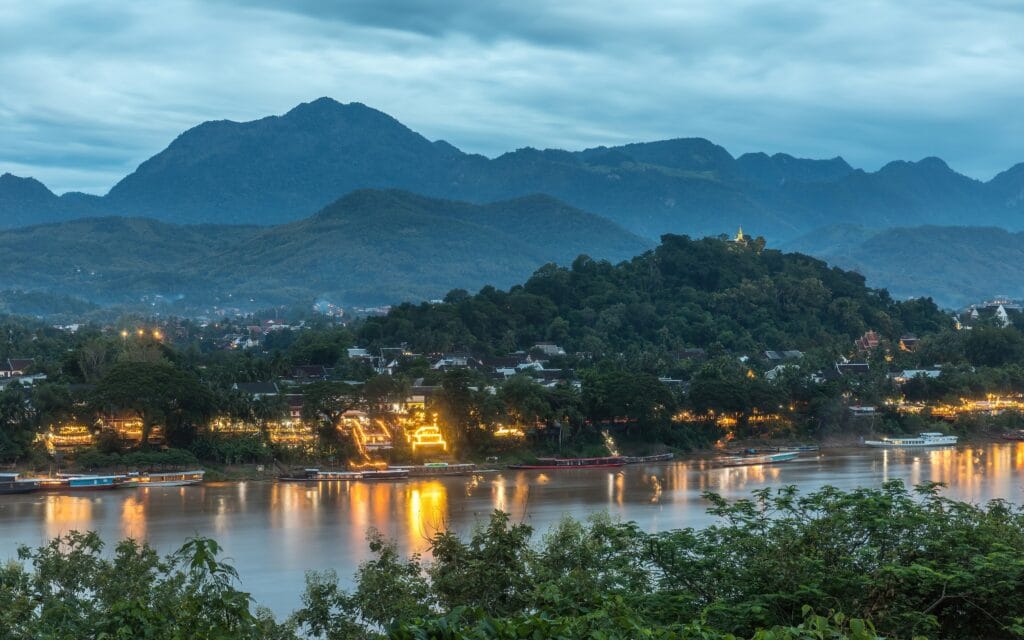
Luang Prabang stands in the mountains of northern Laos, where the Nam Khan river joins the Mekong. It was the seat of the Lao kings until the monarchy ended in 1975. The old town occupies a narrow peninsula between the two rivers, with a wooded hill at its centre. UNESCO listed it in 1995 for the way it combines traditional Lao building with the architecture of the French colonial period.
The town
The name means the royal Buddha image. It refers to the Phra Bang, a gold standing Buddha said to have come from Sri Lanka by way of Cambodia, which is the palladium of the country. It is kept in a chapel in the grounds of the former Royal Palace, now a museum, built for the king by the French in 1904.
There are more than thirty monasteries. The finest is Wat Xieng Thong, founded in 1560 at the tip of the peninsula. Its main hall has roofs that sweep almost to the ground in the manner peculiar to Luang Prabang, and its rear wall carries a mosaic of a tree of life in coloured glass. Others worth seeking are Wat Mai, beside the palace, with its gilded veranda, and Wat Visoun, with a stupa shaped like a watermelon.
Between the monasteries are streets of two-storey houses with shutters and balconies, many of them now small hotels, cafés and bakeries. Mount Phousi, in the middle, is climbed by some three hundred steps for the view at sunset. A night market fills the main street each evening with textiles and paper lanterns.
The alms round
At dawn each day, the monks and novices of the town walk in single file through the streets to receive food from the people, who kneel at the roadside and place sticky rice in their bowls. It is called tak bat and it is a religious act, not a performance.
It has also become the town’s best-known sight, and in the main street the crowd of onlookers can outnumber the monks. Visitors should either watch from across the road, in silence and without flash, or take part properly. To take part, dress with shoulders and knees covered, kneel or sit lower than the monks, remove shoes, do not touch them, and buy rice from the market or through a hotel, not from the hawkers who press it on tourists. The side streets, where residents make their offerings unobserved, give a truer picture than the main one.
Out of town
Kuang Si. Thirty kilometres south, a waterfall drops through the forest into a chain of turquoise pools where swimming is allowed. Go early.
Pak Ou. Two caves in a cliff above the Mekong, two hours upstream by boat, hold thousands of small Buddha figures left by pilgrims. The river journey is the attraction.
The villages. Across the Mekong and along the Nam Khan are villages of weavers, potters and paper makers. Several workshops in town teach natural dyeing and weaving.
Practical advice
November to February is cool and dry. March and April are hot and hazy with smoke from field burning. The rainy months from June to September are green and quiet. Three days are enough for the town and its surroundings.
The Laos-China railway has put Luang Prabang two hours from Vientiane and within reach of Kunming, and there are flights from Bangkok, Hanoi and Siem Reap. Among the hotels, Rosewood Luang Prabang lies in a forest valley outside the town, and La Résidence Phou Vao stands on a hill facing Mount Phousi. Travellers with longer can continue to the Plain of Jars.
Continue
More from Luang Prabang
 LaosLuang PrabangThe old royal capital of Laos, a town of monasteries and colonial villas between two rivers.Read →News · TravelLa Résidence Phou Vao in Luang Prabang Is Joining The Luxury CollectionThe Luang Prabang resort is set to join Marriott’s Luxury Collection in late 2026.September 19, 2026Read →News · TravelLaos-China Railway Opens, Putting Luang Prabang on the Rail MapThe 422-kilometre line from Vientiane to the Chinese border opened on 3 December 2021.December 3, 2021Read →News · TravelRosewood Luang Prabang Opens in a Forest Valley in LaosBill Bensley's 23-key resort opened on 27 March 2018 beside a waterfall outside the old royal capital of Laos.March 27, 2018Read →