Komodo: A Guide to the Dragons, the Reefs and the Boats
The world's largest lizards live on a handful of dry islands between Sumbawa and Flores, in a national park whose waters are as remarkable as its reptiles. How to see both, and from what kind of boat.
Komodo National Park lies in the strait between the Indonesian islands of Sumbawa and Flores. It was founded in 1980 to protect the Komodo dragon and became a World Heritage site in 1991. It covers 1,733 square kilometres, most of it sea, with three larger islands, Komodo, Rinca and Padar, and 26 smaller ones.
The dragons
The Komodo dragon is the largest lizard alive. A male can reach three metres in length and weigh well over a hundred kilograms. It hunts deer, pigs and water buffalo by ambush, and its bite delivers venom that prevents the blood from clotting. About 1,700 live on Komodo and 1,300 on Rinca, with smaller numbers on two islets and on the coast of Flores.
Visitors land at a ranger station on Komodo or Rinca and walk a marked trail with a ranger, who carries a forked stick. Sightings are almost certain. The animals lie in the shade near the station and along the dry stream beds. Rinca is closer to the port and the walk is shorter. Komodo is larger and wilder. The rule is to stay with the ranger, keep several metres away and make no sudden movement.
The islands
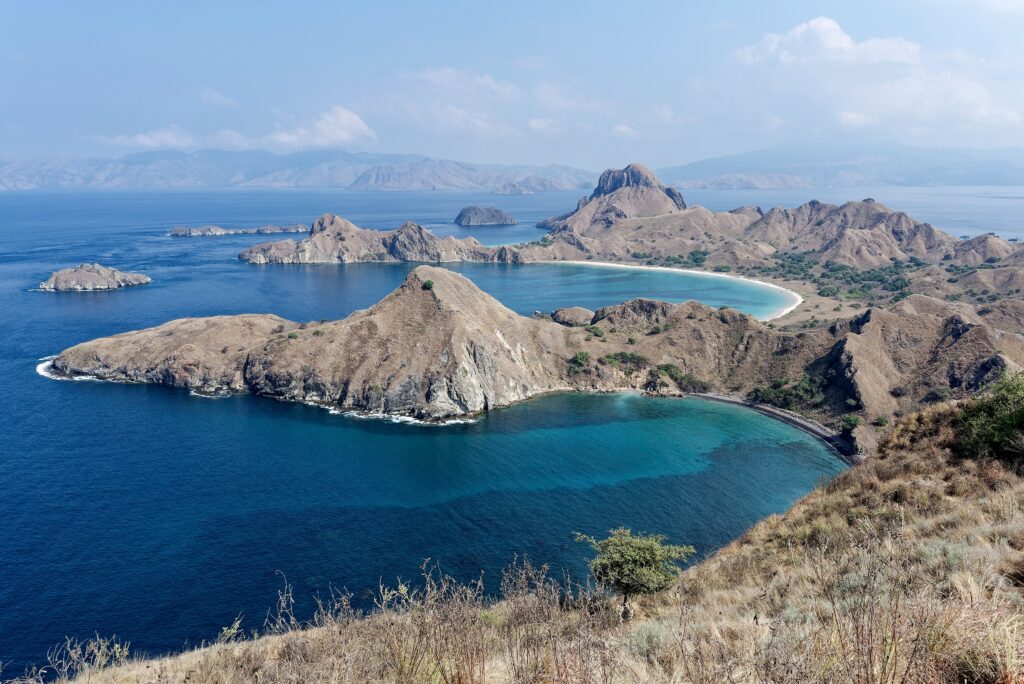
The landscape is unlike the rest of Indonesia. The islands are dry, with brown grass hills, scattered lontar palms and deep bays. The best known view is from the ridge of Padar, reached by a stair of about half an hour, which looks down on three bays with beaches of white, black and pink sand. The pink comes from fragments of red coral, and Pink Beach on Komodo is the usual place to see it.
The sea
Strong currents pour through the strait between the Indian Ocean and the Flores Sea and feed some of the richest reefs in the world. Manta rays gather at cleaning stations and can be seen by snorkellers. Divers come for sites such as Batu Bolong, Castle Rock, Crystal Rock and Manta Alley, where sharks, turtles and great shoals of fish are routine. The currents are powerful, and the park suits experienced divers. Dolphins and, in season, whales pass through.
How to see it
The gateway is Labuan Bajo, a harbour town on the western tip of Flores with flights from Bali and Jakarta. There are three ways to visit.
A day trip. Fast boats leave at dawn and visit Padar, Pink Beach, a dragon island and a manta site in one long day. It is efficient and crowded.
A hotel in Labuan Bajo. The town now has resorts with boats of their own. TA’AKTANA, which opened in 2024, is one.
A liveaboard. The best way is to sleep on the water. A wooden phinisi, the two-masted schooner of Sulawesi, anchors in empty bays and reaches Padar before the day boats. Trips last from two nights to a week. Larger expedition vessels continue east; our account of Aqua Blu describes a voyage from Komodo towards the Spice Islands and Raja Ampat.
When to go
The dry season runs from April to November. The islands are green in April and May and brown by August. July and August are the busiest months. Mantas are most numerous from December to February, when the sea is rougher. Since April 2026 the park has limited visitors to 1,000 a day, after a record 432,000 visits in 2025. Tickets are booked through the official SiOra application, and visits to Padar are divided into three timed sessions of 300 people each. Limits and fees can change, so check the park’s official booking site before you go. Boats and tours should be reserved early for the dry season.
Continue