George Town, Penang: A Guide to Malaysia’s Best-Preserved Old Town
Founded in 1786, the port of Penang kept its shophouses, clan halls and temples while other Asian cities pulled theirs down. It also has the best street food in the country.
George Town is the capital of the island of Penang, off the north-west coast of the Malay peninsula. Francis Light of the East India Company founded it in 1786, and it was the first British settlement in Southeast Asia. For a century and a half it was a free port. Chinese, Indian, Malay, Arab, Armenian and European traders settled in it, and each community built in its own way. UNESCO listed the old town in 2008, together with Malacca.
The old town
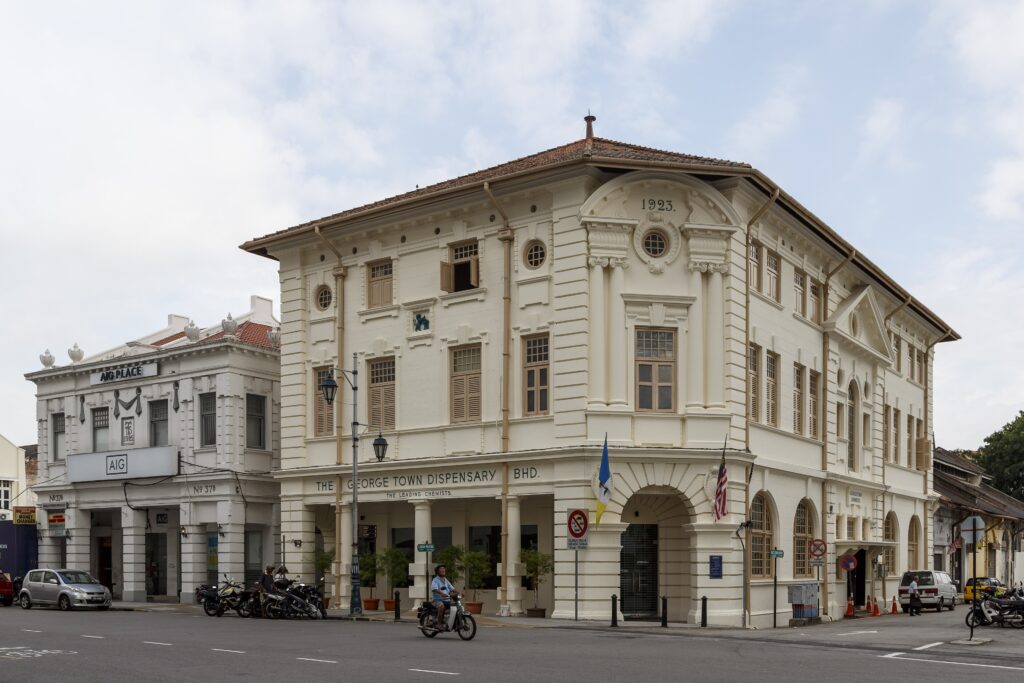
What survives is a grid of more than five thousand shophouses, the narrow, deep buildings of two or three storeys with a shop at the front and a covered walkway along the street. Among them stand the monuments of the different communities.
Khoo Kongsi. The Hokkien clans built halls for the worship of ancestors and the business of the clan. That of the Khoo family, completed in 1906, is the most elaborate, with a roof crowded with ceramic figures and stone carving brought from China. It stands in its own square, hidden behind the houses.
The Blue Mansion. The house of Cheong Fatt Tze, a merchant who made a fortune across Southeast Asia, was built in the 1880s with 38 rooms and five courtyards, according to the rules of feng shui, and painted indigo. It is now a small hotel and is shown on guided tours.
The Pinang Peranakan Mansion. A green town house that shows how the Straits Chinese lived, with gilded screens, English floor tiles and Scottish ironwork.
The Street of Harmony. Along one road stand an Anglican church, a Chinese temple to the goddess of mercy, a Hindu temple and a mosque, each built by its community in the early years of the town.
The clan jetties. On the waterfront, houses on stilts line wooden piers, each belonging to one Chinese clan of boatmen and dock workers. The Chew jetty is the largest.
Street art
In 2012 the Lithuanian artist Ernest Zacharevic painted a series of murals on walls in the old town, several of them combined with real objects, such as a bicycle with two painted children riding it. They became famous, and others followed. They are scattered through the streets and are a good reason to walk.
Food
Penang is regarded by Malaysians as the country’s capital of food, and people travel from Kuala Lumpur and Singapore to eat there. The dishes to try are char kway teow, flat rice noodles fried over fierce heat with prawns and cockles; asam laksa, a sour fish soup with thick noodles, tamarind and mint; Hokkien prawn noodles; and nasi kandar, rice with a choice of curries, the food of the Indian Muslim community. They are sold from stalls in coffee shops and at open-air hawker centres, of which Gurney Drive and New Lane are the best known. The Michelin Guide has covered Penang since 2022. For the coffee shops themselves, see our guide to breakfast in a kopitiam.
Beyond the town
Penang Hill rises to 830 metres behind the town and is climbed by a funicular railway, for cooler air and a view over the strait. At its foot is Kek Lok Si, the largest Buddhist temple in Malaysia, with a pagoda that combines Chinese, Thai and Burmese styles.
Practical advice
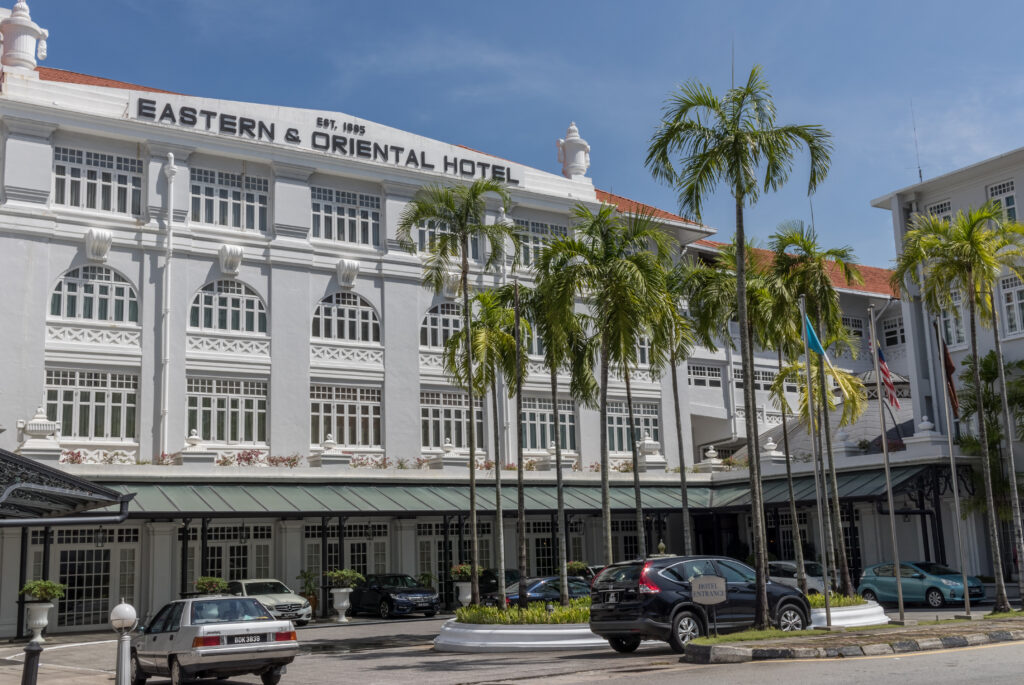
The old town is small and is best seen on foot, early and late in the day. It is hot at any season, with the heaviest rain from September to November. Penang has an international airport and is four hours from Kuala Lumpur by train and ferry. Many of the old houses have become small hotels. The grandest place to stay is the Eastern & Oriental, on the sea front, which appears in our guide to Asia’s grand old hotels.