Melaka: A Guide to the Old Port on the Strait
A Malay sultanate, then Portuguese, Dutch and British in turn, Melaka was for centuries a leading port on the strait that carries its name. Its small old town, listed by UNESCO with George Town in 2008, holds the traces of all of them.
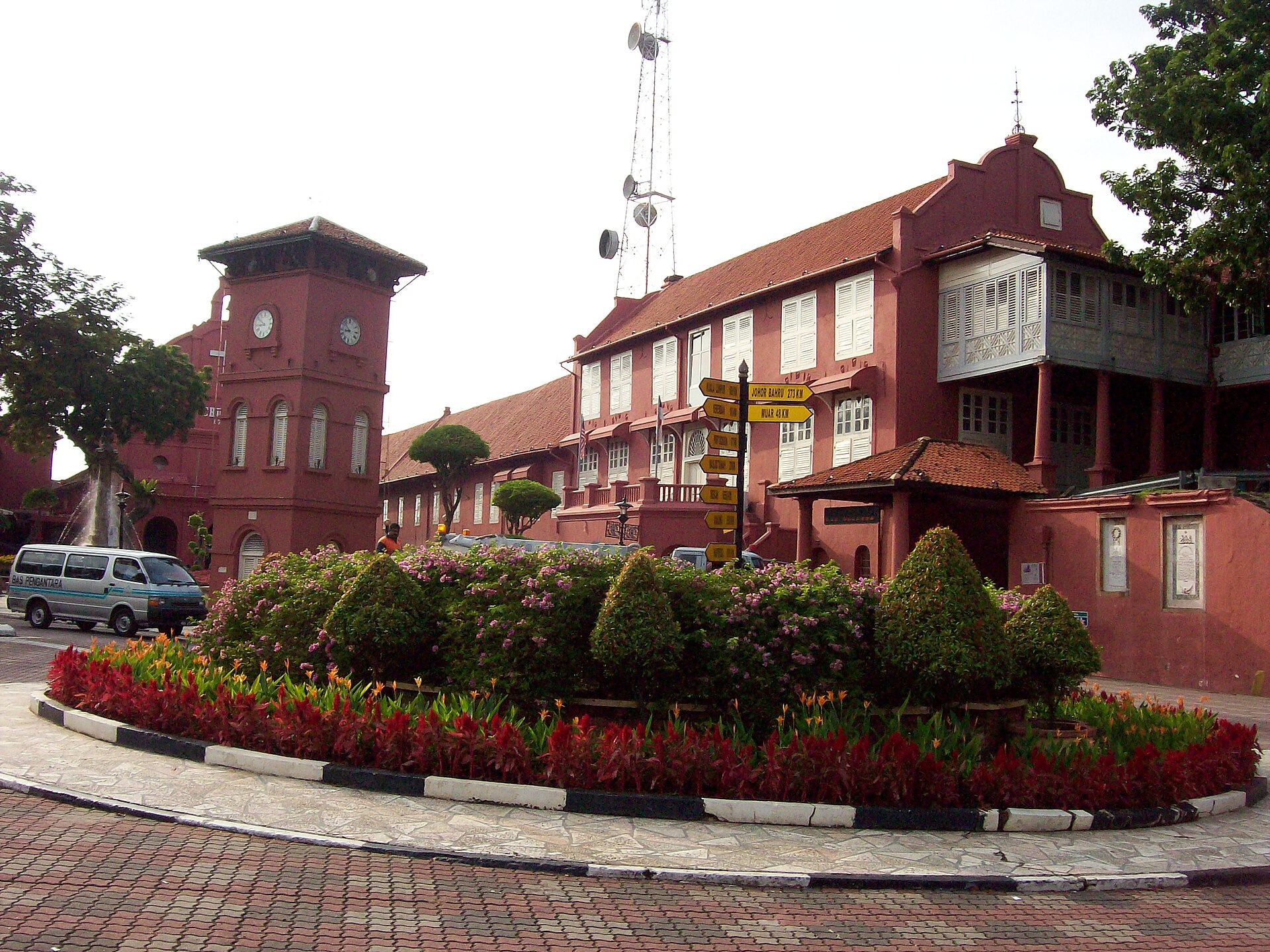 Photo: Philip Nalangan / Wikimedia Commons CC BY 4.0
Melaka lies on the west coast of the Malay peninsula, about 150 kilometres south of Kuala Lumpur, on the strait between Malaysia and Sumatra. For centuries it was one of the main ports on the sea route between India and China, and the powers that held it, in turn a Malay sultanate, the Portuguese, the Dutch and the British, left their marks on the town. UNESCO listed its old town in 2008, together with George Town in Penang, as Melaka and George Town, Historic Cities of the Straits of Malacca.
Four rulers
The town was founded at the end of the fourteenth century by Parameswara, a prince from Sumatra, and became the seat of a Malay sultanate. A Chinese trade envoy arrived in 1403, and the port grew quickly under the protection of the Ming court. Merchants from Gujarat, Java, Arabia and China settled in their own quarters, and the port became a centre for the spread of Islam in the archipelago.
The Portuguese took the town in August 1511 and built a fortress. The Dutch captured it in 1641 and governed it for a century and a half. The British received it by treaty in 1824. By then the harbour was silting up and trade was moving to Penang and Singapore, and Melaka became a quiet provincial town. As in George Town, that decline helped to preserve it.
The hill and the square
The old town is small, and the listed core lies on both banks of the Melaka river, close enough to cross on foot in a few minutes.
On the east bank is St Paul’s Hill, the centre of the colonial town. At its foot stands the Porta de Santiago, a stone gateway that is almost all that remains of A Famosa, the Portuguese fortress built around 1512. The British began to demolish the fortress in 1806, and a timely intervention by Stamford Raffles saved the gate. On top of the hill are the roofless walls of St Paul’s church, with old Dutch tombstones propped against them and a view over the strait.
Below the hill is Dutch Square, where every building is painted red. The Stadthuys, built in 1650 as the residence and office of the Dutch governor, is now a museum of history and ethnography. Christ Church, beside it, dates from the eighteenth century. A replica of the sultan’s wooden palace and a maritime museum in the form of a Portuguese ship are nearby.
Across the river
The west bank was the merchants’ town, and it is the more rewarding half. Jonker Street, officially Jalan Hang Jebat, is the main street of the Chinese quarter, lined with houses that go back to the seventeenth century, many now antique shops, cafés and galleries. At weekends its evening market draws large crowds.
A parallel street was the address of the rich Peranakan families, the descendants of Chinese traders who married locally and created a culture of their own. Their townhouses are long and narrow, with tiled fronts, carved screens and a series of courtyards open to the sky. One is preserved as a museum of Peranakan life. A third street holds a Chinese temple, a mosque and a Hindu temple within a few steps of one another, all founded in the Dutch period.
What to eat
Melaka is closely linked with Nyonya cooking, the cuisine of the Peranakans, which combines Chinese ingredients with Malay spices, coconut and tamarind. The town is also known for chicken rice served with the rice pressed into balls, and for cendol, shaved ice with coconut milk and dark palm sugar. A small community descended from the Portuguese lives by the sea to the south-east of the old town and has dishes of its own.
For travellers
Melaka is roughly two hours by road from Kuala Lumpur and can be seen in a day, but the old town is more pleasant in the evening and early morning, when the day visitors are absent. One night is enough. Weekends are crowded, and weekdays are quieter.
The embroidered blouses shown in the Peranakan houses belong to a tradition that UNESCO recognised in 2024. For breakfast, the town’s old coffee shops serve the toast, eggs and coffee described in our guide to the kopitiam.
Sources: UNESCO World Heritage Centre, Melaka and George Town; Malacca City, Wikipedia; A Famosa, Wikipedia; Stadthuys, Wikipedia.