Wang Shu’s China: The Ningbo Museum and the Xiangshan Campus
The first Chinese citizen to win the Pritzker Prize builds with tiles and bricks salvaged from demolished villages. His two major works stand in Ningbo and Hangzhou, and both can be visited.
In 2012 the Pritzker Architecture Prize went to Wang Shu, an architect based in Hangzhou. He was the first Chinese citizen to receive it. The ceremony was held on 25 May 2012 in the Great Hall of the People in Beijing. The jury praised an architecture rooted in its place and yet universal.
At a time when Chinese cities were being rebuilt at great speed, Wang Shu had made his name by using what the rebuilding threw away.
The Amateur Architecture Studio
Wang Shu was born in 1963 in Urumqi and studied architecture at the Nanjing Institute of Technology, taking his degree in 1985 and a master’s in 1988. In 1997 he founded the Amateur Architecture Studio in Hangzhou with his wife, the architect Lu Wenyu. He joined the faculty of the China Academy of Art in 2000. The name of the studio stands for an approach based on spontaneity, craft skills and cultural tradition.
Early works include the library of Wenzheng College in Suzhou (1999-2000), the Ningbo Contemporary Art Museum (2005), the Ceramic House in Jinhua and the Vertical Courtyard Apartments in Hangzhou, completed in 2007. For the Venice Biennale of 2006 the studio built an installation from 66,000 recycled roof tiles.
The Ningbo Museum
The museum of the history of Ningbo, a project Wang Shu won in 2004 and completed in 2008, opened to the public on 5 December 2008 in the Yinzhou district of the city. From a distance it reads as a single dark block. Higher up it breaks into angular volumes, separated by courtyards, in a composition that refers to the mountains and water of the region.
Its walls are the reason to go. They are built by a local method called wapan, in which mismatched pieces of stone, brick and tile are laid together. The material was salvaged from villages demolished around the city, and pieces of many ages and colours sit side by side. Other surfaces are of concrete cast against bamboo. The museum is reported to have been the first in China built with a large quantity of used materials, and it won the Lu Ban Prize, China’s top construction prize, in 2009.
Inside, the displays run from the Neolithic Hemudu culture to the Republican period, with a collection of bamboo objects.
The Xiangshan Campus
The Xiangshan Campus of the China Academy of Art stands in the hills on the edge of Hangzhou. Wang Shu, who teaches at the academy, built it in two phases, completed by 2007. The buildings are arranged around a hill, with courtyards, covered walks and long ramps.
Roofs and walls reuse tiles salvaged from demolished houses. They give new buildings the weathered grey of a Zhejiang village.
For travellers
Ningbo is a short high-speed train journey from Hangzhou and Shanghai, and the museum makes a half-day visit. Entry has been free, with the museum usually closed on Mondays, but hours change, so check before going. The Xiangshan Campus is a working art school in the south-west of Hangzhou; visitors can usually walk its grounds, but access should be checked beforehand. Both sites are best seen in clear light, when the texture of the walls shows.
Wang Shu’s more recent work includes a hotel: Songtsam Linka Kunming, an urban retreat beside Dianchi Lake, which opened in 2026. In Hangzhou, the campus combines well with a morning on the causeways of West Lake.
Continue
More from Hangzhou
 ChinaHangzhouA lake city of tea hills, temples and Southern Song cuisine, 45 to 60 minutes from Shanghai.Read →
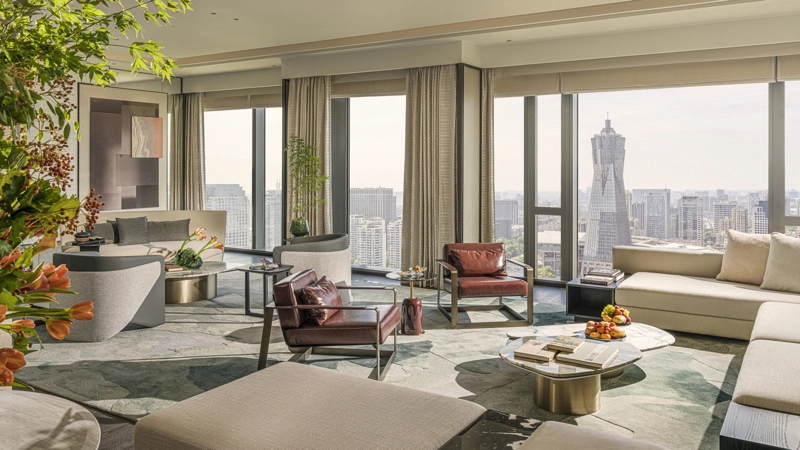 News · TravelFour Seasons Opens Second Hangzhou Hotel at Hangzhou CentreA 214-key tower hotel beside Wulin Square joins the brand's West Lake resort, with AB Concepts restaurants.September 1, 2024Read →
 News · Food & DrinkMichelin Guide Hangzhou 2023: Six Restaurants Get StarsZhejiang cooking dominates Hangzhou's debut Michelin selection, with Jin Sha.May 31, 2023Read →News · TravelRosewood Hangzhou Unveiled With Ole Scheeren and Neri&HuA 16-storey standalone building in Wangjiang New City will house Rosewood's Hangzhou debut.May 10, 2021Read →