Japan’s Subtropical South: Miyako, Taketomi and Yakushima
South of Kyushu, Japan becomes a country of reefs, red tile roofs and rain forest. Three islands show the range: Miyako, with Rosewood's first Japanese resort; Taketomi, a village of Ryukyu houses with a Hoshinoya; and Yakushima, a World Heritage forest of ancient cedars.
Most journeys to Japan stay on the main islands. South of Kyushu the country changes: the climate turns subtropical, the architecture follows the Ryukyu tradition of low houses and red tiles, and the sea becomes the point. OKYTO has covered three of these islands, and they make very different trips.
Miyako: reefs and a new resort
Miyako, in Okinawa prefecture some 300 kilometres south-west of the main island of Okinawa, is a flat island of coral reefs and sugar cane, reached only by air. Rosewood Miyakojima, the brand’s first hotel in Japan, opened in March 2025 on a cape above Oura Bay, with 55 villas and houses by Studio Piet Boon in pale stone and timber. Its restaurants draw on the island’s larder: Nagi cooks Italian food with a Japanese touch beside the sea, and Choma is four Japanese counters, for yakitori, tempura, teppanyaki and sushi, working with Miyako and Okinawan ingredients.
Taketomi: a village of red roofs
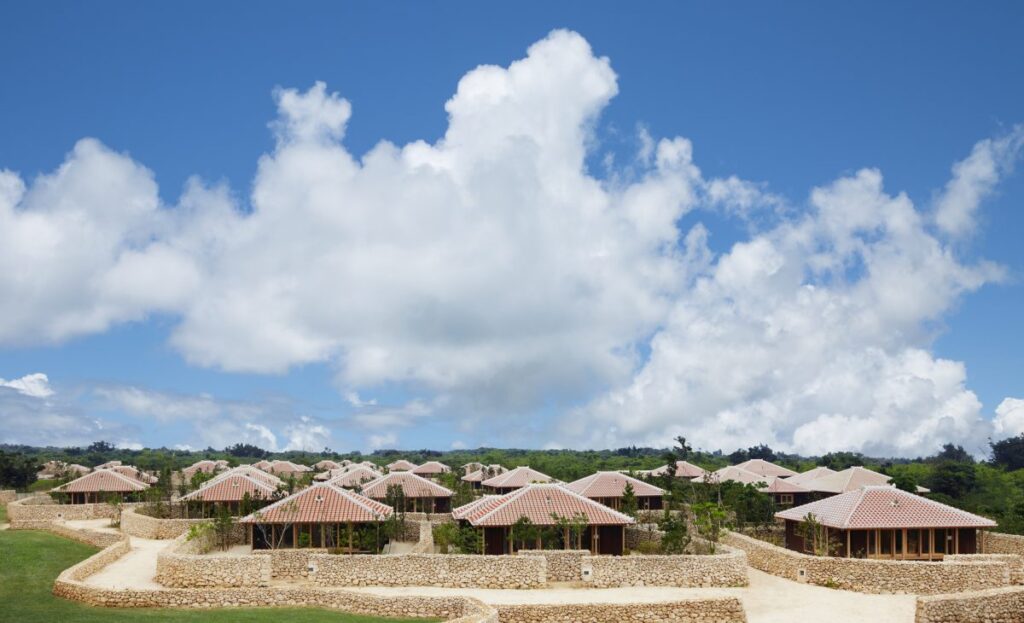
Taketomi is a small island of the Yaeyama group, about ten minutes by ferry from Ishigaki, where buildings must follow the traditional style. Hoshinoya Taketomi Island, opened on 1 June 2012 as the third Hoshinoya, is laid out as a village of 48 single-storey villas under red Ryukyu tiles, with walls of local limestone, shisa guardians on the roofs and gardens of white sand. Its architect, Rie Azuma, is the subject of OKYTO’s portrait Rie Azuma, the architect of Hoshinoya.
Yakushima: the cedar forest
Yakushima, south of Kyushu, is almost all mountain and one of the wettest places in Japan, and in 1993 some 10,700 hectares of its forest became one of Japan’s first four World Heritage sites. Its oldest cedars reach exceptional ages; the best known, Jomon Sugi, is reached by a round trip of about 22 kilometres on foot, described in the hike to the Jomon Sugi.
Choosing between them
Miyako is for the sea and a resort stay; Taketomi for a village and its rhythm, best combined with Ishigaki; Yakushima for walking, and for travellers who do not mind rain. All three sit far from the usual Tokyo and Kyoto circuit, and all three reward several nights rather than a day.
Sources: OKYTO destination, hotel, restaurant, experience and article pages on each island, and their cited sources.
Mentioned
In this story
 HOSHINOYAHoshinoya Taketomi IslandRie Azuma's 48 red-roofed villas on Taketomi, Okinawa, around a 46-metre pool; Nouvelle Ryukyu dining.Discover →Miyakojima · ItalianNagi (Rosewood Miyakojima)Rosewood Miyakojima's Italian restaurant takes its name from a calm sea and builds its menus on Miyako.Discover →Miyakojima · JapaneseChoma (Rosewood Miyakojima)Rosewood Miyakojima's Japanese restaurant splits into four counters, yakitori, tempura, teppanyaki and sushi.Discover →