Uzbekistan by High-Speed Train: Samarkand, Bukhara and Khiva on the Silk Road
Uzbekistan's Silk Road cities in sequence by high-speed train: Tashkent, Samarkand, Bukhara and Khiva, and how to pace the journey.
The Silk Road cities of Uzbekistan were built days of camel travel apart. Today the fast train covers the distance between them in a few hours, which changes what a first trip can include: three great cities in a week, with time left to walk through each rather than only photograph it.
The shape of the journey
The route runs west and then north-west, from Tashkent to Samarkand, on to Bukhara and finally to Khiva, in the desert near the Turkmen border. The Afrosiyob high-speed service links Tashkent and Samarkand in about two hours and Bukhara in roughly four, with Samarkand and Bukhara 90 minutes apart. Since 2026, a newer high-speed service has extended the line to Khiva in about seven and a half hours, running on three days of the week in each direction. Older Sharq trains and overnight services fill the gaps, and tickets are sold on the national railway’s site and app against a passport number. Book early in the busy months, as the fast trains sell out.
Begin in Tashkent only as long as you need to. The capital is a modern Soviet-planned city, useful for arrival, and the real journey starts at the station. The high-speed train along the Silk Road is as much the pleasure as the means.
Samarkand: the Timurid capital
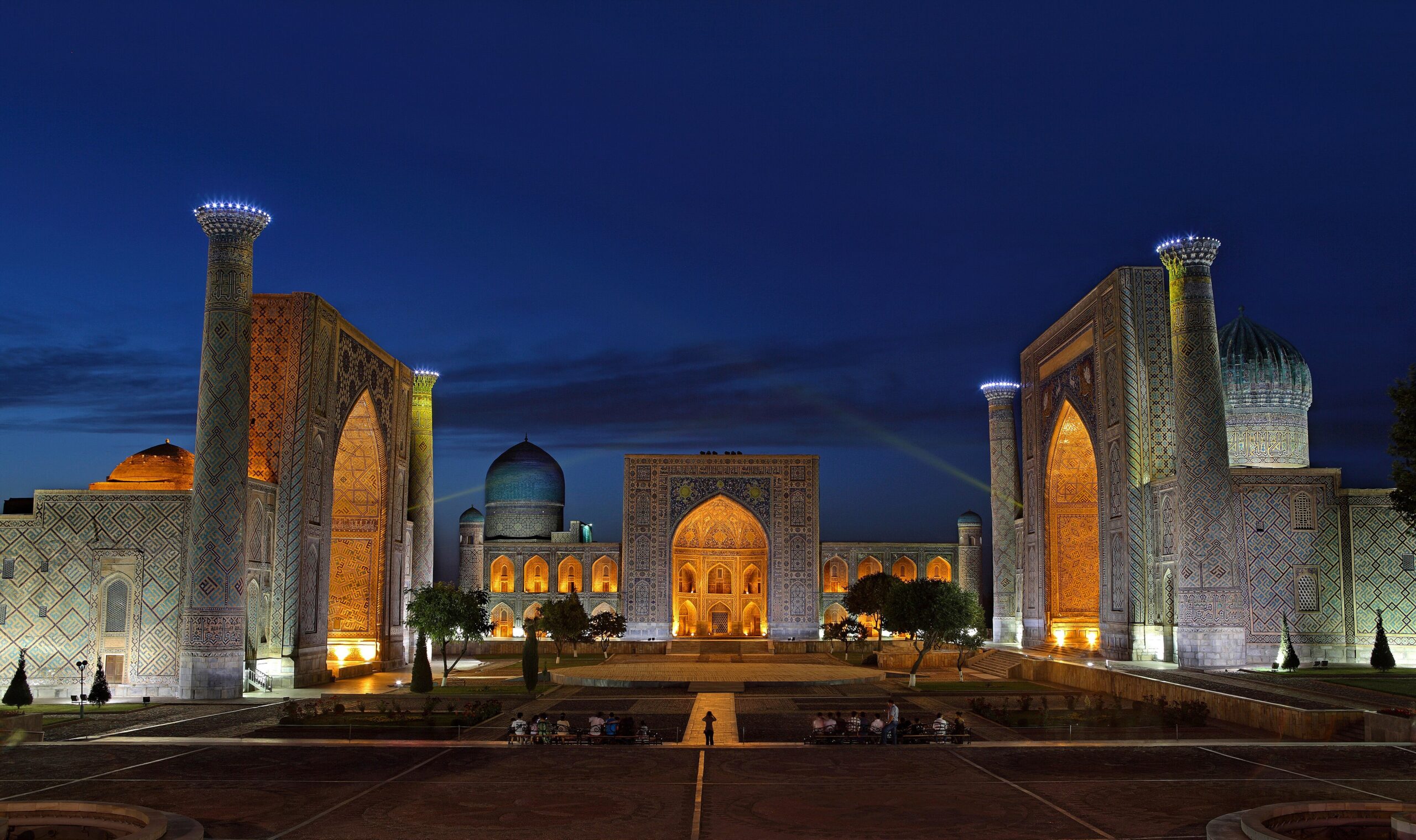
Samarkand is the city of Timur and his successors, and the 14th and 15th centuries gave it its character. The Registan, a square framed by three tiled madrasas, is the image everyone knows, but the city rewards a slower route: the long staircase of tombs at Shah-i-Zinda, the vast ruin of the Bibi-Khanum mosque, the Gur-e-Amir mausoleum and the remains of Ulugh Beg’s observatory. The old city lies mainly east of the Russian-built quarters, where traditional courtyard houses survive. Allow two nights and see the Registan early and again at dusk, when the light is kinder. Standing in the Registan at either end of the day is the best introduction.
Bukhara: a medieval town intact
Bukhara is the most complete medieval town in Central Asia, valued less for any single building than for its fabric: trading domes at the crossroads, madrasas, a rebuilt citadel and lanes that still follow their medieval plan. Two monuments stand out for age and craft: the tomb of Ismail Samani, from the 10th century, and the Kalyan minaret, an 11th-century tower of patterned brick. In 2025 the city held its first biennial, a sign of how quickly it is becoming a contemporary art destination as well as a historic one. Three nights suit it, with time to walk the old town in the early morning and again after dark, when the domes are lit.
Khiva: the walled town
Khiva ends the route at the edge of the Kyzylkum desert. Its inner town, Itchan Kala, is a rectangle of brick walls about 650 by 400 metres, with madrasas, mosques and houses packed within. The Juma mosque, with its forest of carved wooden columns, has 212 carved wooden columns. The town is small enough to see in a day, but it is best slept in, so that the walls and streets can be walked with fewer visitors. A walk along the walled town of Khiva at either end of the day shows it at its best.
Planning the rhythm
A week works as: one night in Tashkent, two in Samarkand, three in Bukhara and two in Khiva, ending with the train back or a flight from nearby Urgench. Travel days are best spent on the morning trains, which leave time for the afternoon. Between May and October, expect heat: the early and late hours are for walking, the middle of the day for the shade of a courtyard. For dinner in Tashkent, Caravan is a good place for Uzbek dishes.
Sources: Journal of Nomads: Uzbekistan railways guide; Eurasia Travel: Tashkent–Khiva high-speed train; UNESCO: Samarkand – Crossroad of Cultures; UNESCO: Historic Centre of Bukhara; UNESCO: Itchan Kala; Biennial Foundation: Bukhara Biennial. Check the official websites for current information.
Dine
Restaurants in this guide
Experiences
Experiences in Uzbekistan
Journal