Bukhara Holds Its First Biennial in Restored Caravanserais and Madrasas
From 5 September to 20 November 2025 the old Silk Road city showed more than 70 commissions made by international artists with Uzbek craftsmen, under the title Recipes for Broken Hearts.
The first Bukhara Biennial opened on 5 September 2025 and ran for ten weeks, until 20 November. It took place in the historic centre of Bukhara, the Silk Road city in Uzbekistan that has been a UNESCO World Heritage site since 1993. The title of the edition was Recipes for Broken Hearts.
The idea
The biennial was commissioned by Gayane Umerova, who chairs the Uzbekistan Art and Culture Development Foundation, and directed by the American curator Diana Campbell. There were more than 70 commissions, all made for the place, with over 200 participants from 39 countries.
Each work was produced in Uzbekistan by an artist working with local craftsmen. The crafts included woodcarving, ikat weaving, embroidery, ceramics and mosaic. The makers were credited alongside the artists. The title is taken from an Uzbek legend about the invention of the rice dish plov as a cure for a broken heart. Food and healing ran through the programme, and meals were part of several works.
The setting
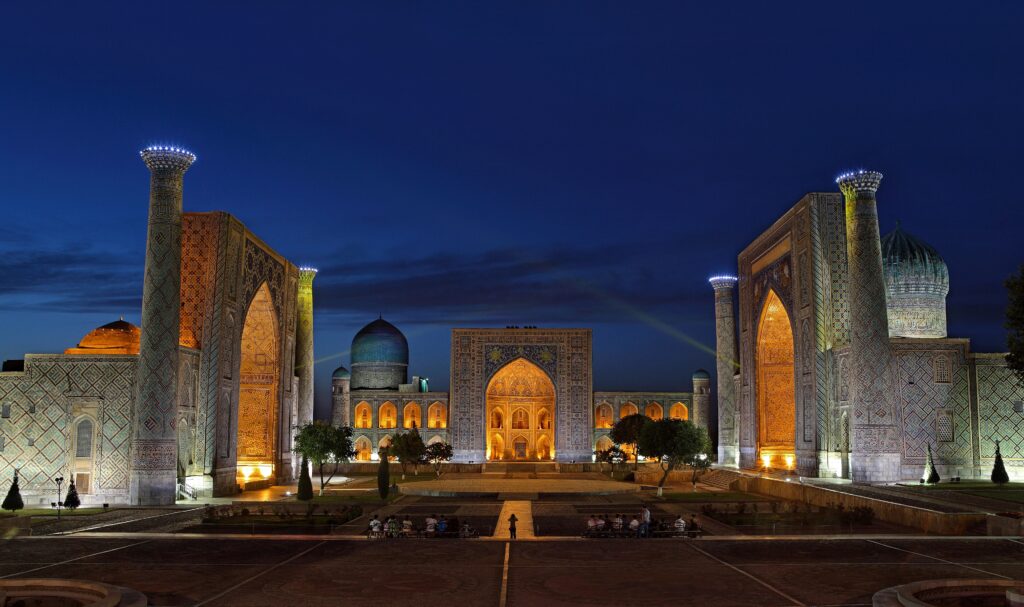
The works were shown in and around buildings that had been closed or neglected and were restored for the occasion, among them caravanserais where merchants once lodged with their goods, and madrasas. The Lebanese architect Wael Al Awar directed the architecture and drew up a plan that joined the sites by a walking route. Monuments on the route included the Khoja Kalon mosque, the Mir-i-Arab madrasa and the Magoki-Attori mosque.
Antony Gormley built a labyrinth of figures in unfired brick beside the Khoja Kalon mosque. The Indian artist Subodh Gupta made a domed pavilion of enamel dishes in which food was served. The Brazilian artist Erika Verzutti contributed a tower of carved wooden pomegranates.
For travellers
Bukhara is about two hours from Samarkand and four from Tashkent by the Afrosiyob high-speed train. The old city is small and is seen on foot. Its domed bazaars, the Kalon minaret and the Ark fortress are open all year. The restored buildings remain in use after the biennial, and a second edition has been announced for 3 September to 21 November 2027, under the direction of the architect Kulapat Yantrasast.
The biennial came a week before another opening in Central Asia, that of the Almaty Museum of Arts in Kazakhstan.