Yogyakarta: Three Days in Java’s Court City
Yogyakarta is the only Indonesian region headed by a recognised monarchy, its sultan. His palace stands at the centre of a city laid out between a volcano and the ocean, with Borobudur and Prambanan within a day trip.
Yogyakarta lies in the south of central Java, on a fertile plain below Mount Merapi. It is a city of about 375,000 people at the centre of an urban area of four million, and it is regarded as the home of classical Javanese culture: court dance, gamelan music, shadow puppetry, batik and silverwork.
The sultanate
In 1755 a treaty divided the old Javanese kingdom of Mataram in two. One half kept its court at Surakarta. The other became the sultanate of Yogyakarta under Hamengkubuwono I, who moved into his new palace in October 1756.
The sultans survived the Dutch, an attack by British forces under Stamford Raffles in 1812, and the Japanese occupation. When Indonesia declared independence in 1945, Sultan Hamengkubuwono IX immediately supported the republic, and from 1946 the city served as its capital while the Dutch held Jakarta. In return, Yogyakarta was made a special region in which the sultan is governor by right. The present sultan, Hamengkubuwono X, holds both offices.
The axis
The first sultan laid out his city on a straight line running from north to south. At the northern end is a white monument, the Tugu. From it the main street, Malioboro, runs to the palace. South of the palace the line continues to a hunting pavilion. Extended in either direction, it points to the summit of Merapi and to the Indian Ocean, the two powers between which the kingdom lay. In 2023 UNESCO inscribed this plan as The Cosmological Axis of Yogyakarta and its Historic Landmarks.
Day one: the Kraton and the old city
The Kraton is a walled city within the city. The palace itself is a sequence of courtyards with open pavilions on carved and gilded columns, in the traditional Javanese manner, shaded by old trees. Part of it is a museum of the sultans. The court retainers, in batik sarongs with a dagger at the back, still serve here, and gamelan, dance, sung poetry and shadow puppetry are performed for visitors on different mornings.
Taman Sari, a short walk away, was the pleasure garden of the first sultan, begun in 1758: bathing pools, pavilions and underground passages, partly ruined, with reconstruction work under way since 2004. The afternoon is for Malioboro and its batik shops.
Days two and three: the temples
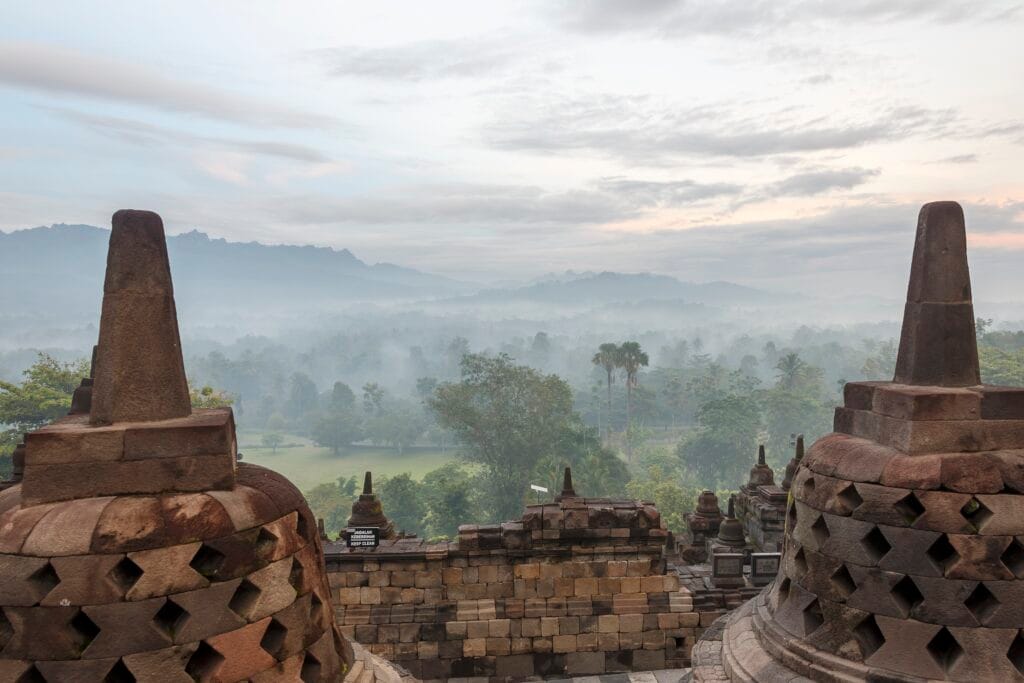
Borobudur, about 40 kilometres to the north-west, is generally described as the world’s largest Buddhist temple. Climbing the monument is limited by a daily quota, in timed groups, so tickets should be booked ahead; check the official ticketing rules before you go. Take the first slot of the morning.
Prambanan, 17 kilometres to the north-east, is a group of Hindu towers of the same century. It is best seen late in the day, and the Ramayana ballet is staged in the evening beside it on certain dates, so check the schedule.
Crafts and food
Batik is made by drawing or stamping a pattern in wax on cloth before dyeing. The court of Yogyakarta has its own patterns in brown, indigo and white, some once reserved for the royal family. Workshops in the streets south of the Kraton show the process. The city is also known for its silversmiths.
The local dish is gudeg, young jackfruit simmered for hours in coconut milk and palm sugar. In the markets and on the pavements, women sell jamu, the herbal drinks of Java, from bottles carried in a basket.
For travellers
The dry season, from June to September, is the best time. The wettest months fall around the turn of the year. Yogyakarta International Airport, opened in stages in 2019 and 2020, is in Kulon Progo, well to the west of the city. Trains run to Jakarta and Surabaya. Mount Merapi is one of the most active volcanoes in Indonesia, and its condition occasionally affects access to the northern slopes and, at times, flights.
Most travellers arrive from Bali or Jakarta. In the west of the island, the Whoosh high-speed train links Jakarta and Bandung; it does not run to Yogyakarta.