How to Visit Borobudur Now: The New Rules for Climbing the Temple
Since 2023 only 1,200 people a day may climb the world's largest Buddhist monument, in guided groups, for one hour, wearing woven sandals supplied at the gate. What that means for planning a visit.
Borobudur stands on a low hill in the Kedu plain of central Java, ringed by volcanoes. It was built in the eighth and ninth centuries under the Sailendra dynasty, and it is the largest Buddhist monument in the world. For years it was also one of the most crowded. In 2023 the Indonesian authorities changed the way it is visited.
The monument
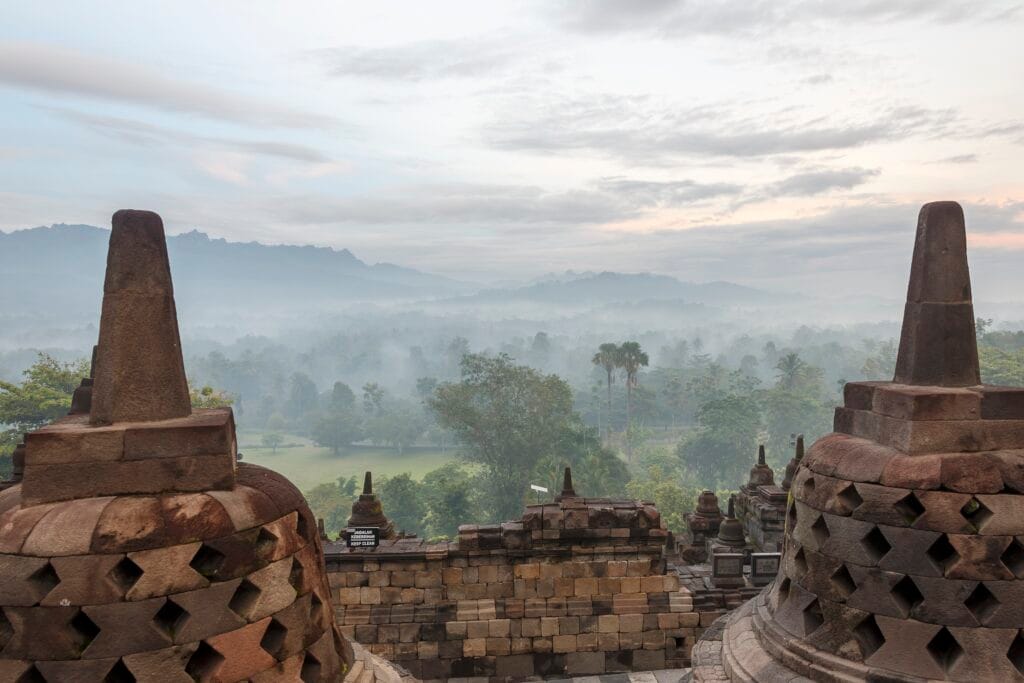
Borobudur is not a temple with an interior. It is a hill encased in stone, a stepped pyramid 123 metres square at the base and 35 metres high, which the pilgrim climbs. There are nine levels. The lower six are square terraces, with galleries whose walls are carved with 2,672 panels of relief. Read in order, by walking clockwise round each level, the narrative panels tell the lives of the Buddha and the journey of a seeker towards enlightenment. The upper three levels are round and open to the sky. On them stand 72 bell-shaped stupas of pierced stone, each containing a seated Buddha, around a large central dome. There were once 504 Buddha figures in all.
The monument was abandoned, probably after the tenth century, and was covered by ash and jungle. Thomas Stamford Raffles, then governing Java for the British, had it cleared in 1814. Between 1975 and 1982 it was taken apart and rebuilt on a new foundation with drainage, in a project led by UNESCO, and it became a World Heritage site in 1991.
What changed
Millions of shoes had worn hollows in the stairs, and the weight of the crowds was a concern for the structure. After a period in which the upper levels were closed altogether, the monument reopened to climbers in 2023 under new rules.
No more than 1,200 people may go up in a day. They are admitted in groups at fixed hours, each with a guide, and may stay on the structure for one hour. Everyone wears a pair of sandals called upanat, woven from pandan leaves by craftsmen of the nearby villages, with soft soles that do not abrade the stone. They are handed out at the entrance and kept as a souvenir. A separate, cheaper ticket admits visitors to the park and the foot of the monument without the right to climb. Limits, prices and opening days can change, so check the official Borobudur ticket site before you plan.
How to plan
Climbing tickets are sold online for a named time and sell out, especially at weekends and in the holiday months of July and August. Book as soon as dates are fixed, and choose the first slot of the morning, when the air is clear and the volcanoes are visible. Closing days and hours should be checked on the official ticket site.
One hour is short. The guide will lead the group up the eastern stair and round one or two galleries before the upper terraces. To make the most of it, read about the reliefs beforehand, and afterwards walk round the base, where the carving can be studied without a time limit. A favourite dawn view is from the hill of Punthuk Setumbu, to the west, with the monument rising out of the mist below.
On the full moon of Vesak, in May or June, monks walk in procession from the small temple of Mendut, past Pawon, to Borobudur. The three temples stand on a straight line and were built as a group. Both of the smaller ones are worth the short drive.
Where to stay
Borobudur is an hour and a half from Yogyakarta, the cultural capital of Java, and about the same from its new airport. Most visitors come out for the day. Staying nearby makes the early slot easy, and the countryside of rice fields and villages is a pleasure in itself. The best known hotel is Amanjiwo, built of local limestone in a form that echoes the monument and faces it across the plain. A day in Yogyakarta, for the sultan’s palace, the Hindu temples of Prambanan and a glass of jamu, completes the visit. Java’s first high-speed train, Whoosh, serves the west of the island, between Jakarta and Bandung.