Phnom Penh: A Three-Day Guide to Cambodia’s Capital
Most travellers give Phnom Penh a night on the way to Angkor. The Royal Palace, a major museum of Khmer sculpture and a remarkable body of 1960s architecture justify three days on the river.
Phnom Penh stands at a meeting of rivers. The Tonle Sap flows in from the great lake to the north-west, joins the Mekong, and the combined water leaves by two channels, the Mekong and the Bassac. The Khmer call the place Chaktomuk, the four faces. About two million people live in the city.
A short history
According to legend, in 1372 a woman named Penh found four Buddha images inside a tree floating in the river, and had a hill raised and a temple built to house them. The hill is Wat Phnom, and the name of the city means the hill of Penh. The Khmer kings moved their capital here from Angkor in 1434, abandoned it for other sites, and returned for good in the 1860s under King Norodom, at the start of the French protectorate.
The French gave the city its boulevards and villas. After independence in 1953 came a period of building in a confident modern style, and Phnom Penh in the 1960s was known as the pearl of Asia. On 17 April 1975 the Khmer Rouge entered the city and forced its entire population into the countryside. It stood almost empty until 1979. In 1998 it had 862,000 inhabitants. The recovery since then has been rapid, and towers now rise behind the old riverfront.
Day one: the palace and the museum
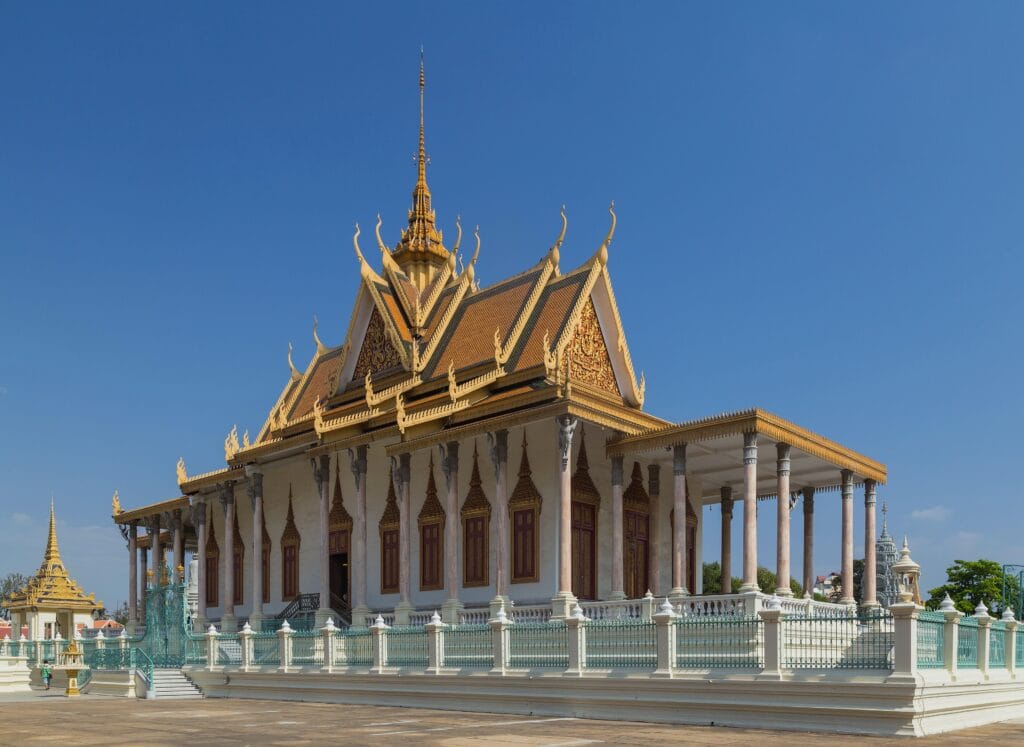
The Royal Palace was begun in 1866 and faces the river. It is the residence of the king, and part of it is closed, but the ceremonial buildings can be visited. The Throne Hall, inaugurated in 1919, has a tiered roof and a spire 59 metres high. Within the same walls is the Silver Pagoda, whose floor is laid with 5,329 silver tiles. It holds a small Buddha of green crystal and a standing Buddha made with 90 kilograms of gold and set with diamonds. Our account of the visit gives the details.
The National Museum is just north of the palace. The French scholar George Groslier designed it in the form of a Khmer temple around a courtyard garden, and it opened at the Khmer New Year of 1920. It holds more than 14,000 objects. The stone and bronze sculpture from Angkor and from the earlier kingdoms makes it one of the world’s largest collections of Khmer art. The museum was abandoned from 1975 to 1979 and reopened damaged. Sculptures that left the country illegally in those decades are now being returned to it from collections abroad.
End the day on Sisowath Quay, the promenade along the Tonle Sap, when the city comes out to walk.
Day two: the recent past and the markets
The Tuol Sleng Genocide Museum is a former school that the Khmer Rouge used as a prison and interrogation centre. Choeung Ek, outside the city, is one of the places where its prisoners were killed. The two visits are hard, and for most travellers they are necessary for understanding the country.
In the afternoon, the Central Market, a domed art deco building of the 1930s, and Wat Phnom on its small wooded hill are close together in the north of the centre.
Day three: the modern city
The buildings of the 1960s are a lesser-known reason to come. The Independence Monument, the Chaktomuk Conference Hall on the riverfront and the National Sports Complex are all by Vann Molyvann, who adapted modern architecture to the Cambodian climate and to Khmer forms. Our article on Vann Molyvann and the New Khmer Architecture explains what to look for. Specialist guides lead tours of these buildings.
For travellers
The dry season, from December to April, is the time to go, and December and January are the coolest months. Rain falls from May to November. Techo International Airport, which began operating in September 2025, lies to the south of the city in Kandal province, and the transfer takes longer than the distance suggests, so allow generous time.
Rosewood Phnom Penh occupies the upper floors of the Vattanac Capital tower. The city is also a port of call for river cruises between Vietnam and Cambodia, and most itineraries continue to Siem Reap and the temples of Angkor.
Continue
More from Phnom Penh
 CambodiaPhnom PenhCambodia's riverside capital: the Royal Palace and Silver Pagoda.Read →News · TravelPhnom Penh’s New Airport Opens Under a Roof by Foster + PartnersTecho International Airport received its first flights on 9 September 2025, replacing the old city airport.September 9, 2025Read →News · TravelRosewood Phnom Penh Opens at the Top of Vattanac CapitalRosewood's first city hotel in Southeast Asia opened in February 2018.February 16, 2018Read →