Samarkand: The Registan, Shah-i-Zinda and the Monuments of Timur’s Capital
Timur made Samarkand his capital in 1370 and rebuilt it with craftsmen from across his empire. A guide to what remains: the Registan, the avenue of tombs at Shah-i-Zinda, Bibi-Khanym, Gur-e-Amir and Ulugh Beg's observatory.
Samarkand is one of the oldest cities of Central Asia. It dates back to the seventh century BC. Alexander the Great took it in 329 BC, when it was known as Maracanda. Genghis Khan took it in 1220 and left much of it in ruins. Its great period began in 1370, when the conqueror Timur, known in Europe as Tamerlane, made it his capital. Over the next thirty-five years he rebuilt the city with architects and craftsmen brought from the lands he had conquered, and his descendants continued the work. UNESCO listed the city in 2001 as Samarkand – Crossroad of Cultures.
Most of what a visitor comes to see dates from the century after 1370. The monuments are spread across the city, among Russian and Soviet streets, and need two days.
The Registan
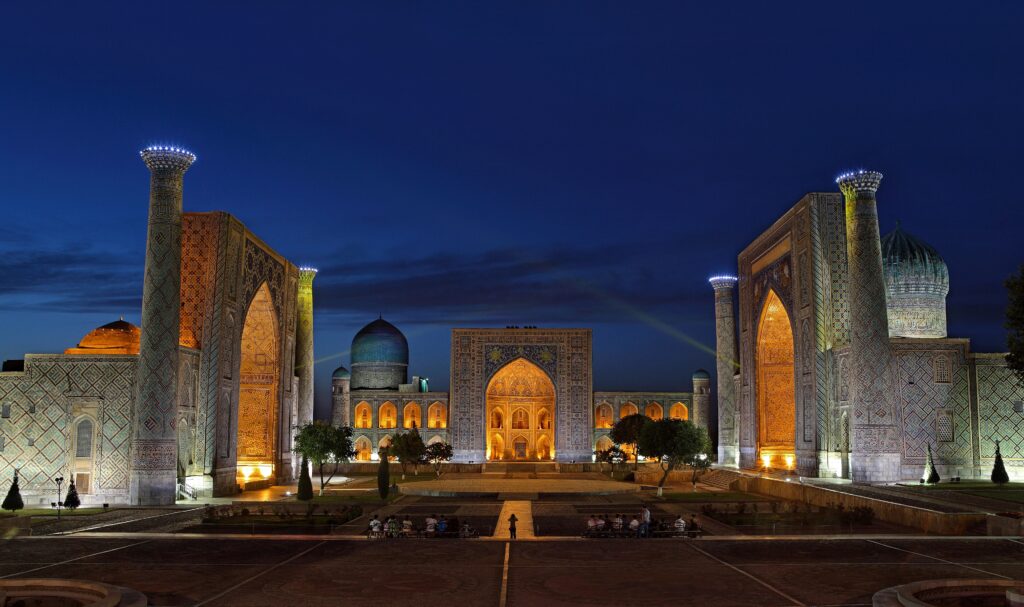
The centre of the Timurid city is a square enclosed on three sides by madrasas. The oldest was built between 1417 and 1420 by Ulugh Beg, Timur’s grandson. The other two were added in the seventeenth century by the Uzbek governor Yalangtush Bakhodur: the Sher-Dor, with tigers in mosaic above its arch, between 1619 and 1636, and the Tilya-Kori, with a gilded mosque inside, between 1646 and 1660.
Shah-i-Zinda
Shah-i-Zinda is a necropolis on the slope of the old city mound, whose earliest structures date from the eleventh or twelfth century, around the shrine of Qutham ibn Abbas, a cousin of the Prophet Muhammad who is said to have brought Islam to the region. The name means “the living king”.
A stair leads up from the gate to a narrow lane lined on both sides with mausoleums, most of them built in the fourteenth and fifteenth centuries, among them tombs of members of Timur’s family and of his commanders. Their portals are covered in glazed tile in turquoise, cobalt and white. The lane is narrow, so the tilework is seen at close range, as it cannot be at the Registan. The shrine at the far end is still a place of pilgrimage, and visitors should dress and behave accordingly.
Bibi-Khanym Mosque
After his campaign in India in 1398 and 1399, Timur ordered a congregational mosque on a scale beyond anything in his empire. It is said to have used more than 400 marble columns and buttresses. The building decayed over the centuries, and an earthquake in 1897 brought down part of the portal. What stands today has been extensively restored since the Soviet period, and work continues, but it gives the measure of the original. A huge stone lectern for the Koran stands in the courtyard. The city’s main bazaar is next door.
Gur-e-Amir
Timur’s own tomb is a compact building under a ribbed turquoise dome. The outer walls are patterned in glazed brick, with tiles arranged to spell out religious words. Inside, the chamber is richly decorated in gilding. Timur lies under a slab of dark jade, with his sons and grandsons around him, among them Ulugh Beg.
Ulugh Beg’s observatory
Ulugh Beg was a ruler by inheritance and an astronomer by choice. In the 1420s he built an observatory on a hill outside the city, centred on a giant meridian instrument with a radius of about 40 metres, set in a trench cut into the rock. With it his astronomers compiled a catalogue of about a thousand stars, published in 1437. The observatory was destroyed around 1449, after his death. The lower part of the curved track was uncovered by the archaeologist Vassily Vyatkin in 1908 and can be seen beneath a modern vault, beside a small museum.
Afrasiyab and paper
North of the bazaar is Afrasiyab, the bare mound of the city that existed before the Mongol conquest, with a museum holding wall paintings of the seventh century. Samarkand was also one of the first centres of papermaking outside China; legend attributes the craft to Chinese prisoners taken at the battle of Talas in 751. Workshops near the city now make paper by hand in the traditional way.
For travellers
The Afrosiyob high-speed train from Tashkent takes roughly two to two and a half hours, and continues to Bukhara. Samarkand also has an international airport. April to June and September to October are the best months. On the first day, see the Registan early, then Bibi-Khanym, the bazaar and Shah-i-Zinda, which are within walking distance of each other. On the second, visit Gur-e-Amir, the observatory and Afrasiyab, and return to the Registan after dark.
Much of the tilework in the city was restored, and in places remade, during the Soviet period and since, and the debate about how far restoration should go is part of the story.