Azerai Can Tho
Sixty pavilions on a low islet in the Hau River, rebuilt from an abandoned resort around its banyans and engineered for a river that rises and falls by metres every day.
- Neighbourhood
- Au islet, Hau River, Can Tho
- Rooms
- 65
- Opened
- January 2018
- Design
- Pascal Trahan
Con Au is a low islet in the Hau River, one of the two main branches of the Mekong in Vietnam, a few minutes by boat from the waterfront of Can Tho, and Azerai Can Tho occupies all of it. There is no road; it is reached only by boat. It opened in January 2018 as the second hotel of Azerai, the brand Adrian Zecha started after Aman, and the first in Vietnam, for the Vietnamese developer Novaland, which counted it as its first resort; in 2019 DEG, the German development finance institution, committed $20 million to its development.
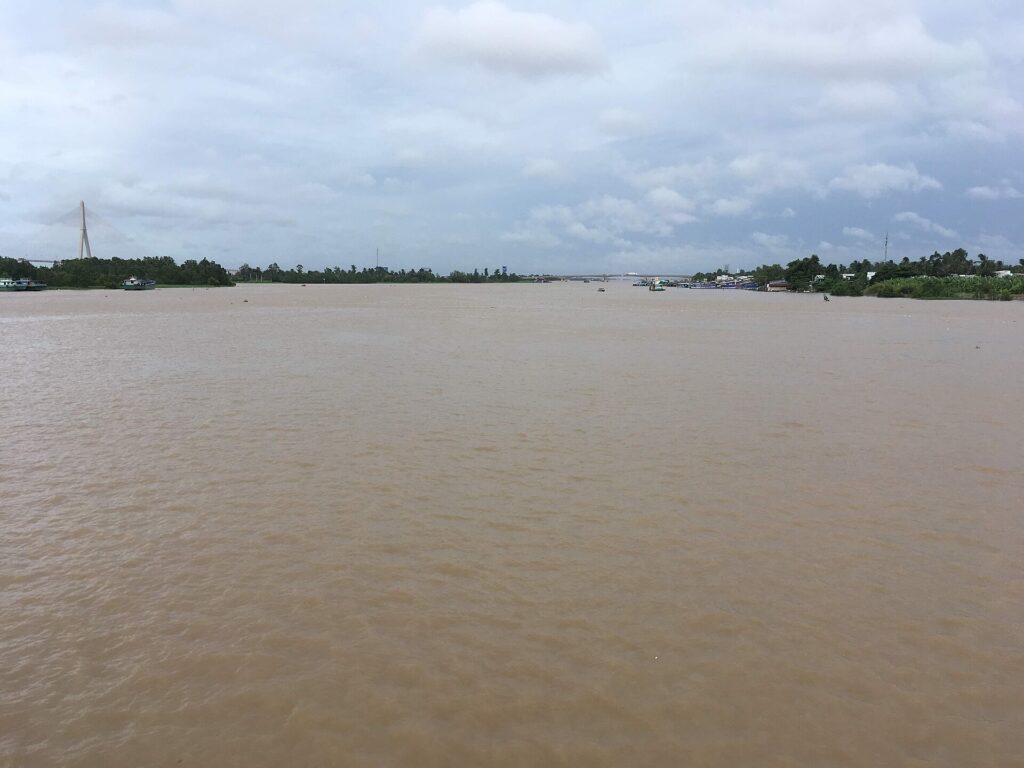
Can Tho is the largest city of the Mekong Delta, and much of its trade still moves on water. The floating wholesale market at Cai Rang, a short way downstream, does its business from boat to boat from first light; OKYTO's guide to the Cai Rang floating market explains how it works, and its survey of five floating markets of the delta goes further upriver. Ho Chi Minh City is about two and a half hours away by road.
An island rebuilt for the river
The resort was not built on empty ground. The islet already held an older resort, abandoned, and the design that began in 2015 kept what had grown up around it: every banyan tree, the lotus pond, the mangroves along the river and the planting on the canal bank. Among them the French-Canadian architect Pascal Trahan set 60 single-storey pavilions with high pitched roofs and covered terraces, along the shore and around a central lake, each opening onto the river, the lake or the gardens; five pool villas, of one to five bedrooms, were added later. The spa stands under the banyans beside the canal.
What a guest does not see is how much of the island was engineered for the water. The landscape architects recorded the river rising and falling by two to three metres in the course of a day, and rebuilt each edge for it. On the Hau, the banks were set back from the water, faced in permeable concrete blocks and planted with beach morning glory to hold the soil; along the canal and at the pier, earth dams faced with the same blocks stand on concrete piling.
Overflow water runs first into green areas around the island's perimeter, where it soaks into the ground, and then through drains into the lotus pond, from which it is pumped away. The lotus pond, kept from the old resort, is part of the island's flood defences.
The Cafe is the resort's main restaurant, and is open to guests from outside the island; OKYTO's guide to what to eat in the Mekong Delta covers the cooking of the region.
Sources: Azerai; Landezine International Landscape Award; VietnamNet; VietnamFinance; The Leader.
Location
- Website
- Official website
