Uzbekistan by High-Speed Train: Tashkent, Samarkand and Bukhara
The Spanish-built Afrosiyob runs at up to 250 km/h between the three great cities of the Silk Road. It has made a week in Uzbekistan one of the easiest journeys in Asia to plan.
The monuments of Uzbekistan are spread along a line 600 kilometres long. Until 2011 the journey between them meant long days on the road or slow overnight trains. Since then a high-speed service has linked the capital, Tashkent, with Samarkand and Bukhara, and most visitors now plan their journey around it.
The train
The service is called Afrosiyob, after the ancient city that preceded Samarkand. It began on 8 October 2011 between Tashkent and Samarkand and was extended to Bukhara in August 2016. The trains are Talgo 250 sets built in Spain, with eight passenger cars and a dining car, and run at up to 250 kilometres an hour.
Tashkent to Samarkand takes a little over two hours. Tashkent to Bukhara takes about three hours and twenty minutes, where the old train took seven. There are three classes, and seats are reserved. In May 2026 six new trains built by Hyundai Rotem of South Korea entered service, each with seven cars and 351 seats, and high-speed services were extended beyond Bukhara to Urgench and Khiva, in the far west.
The classic route
Tashkent. Most flights arrive in the capital. It was rebuilt after an earthquake in 1966 and is a city of wide avenues, Soviet modernist buildings and a metro with decorated stations. A day is enough before taking the morning train.
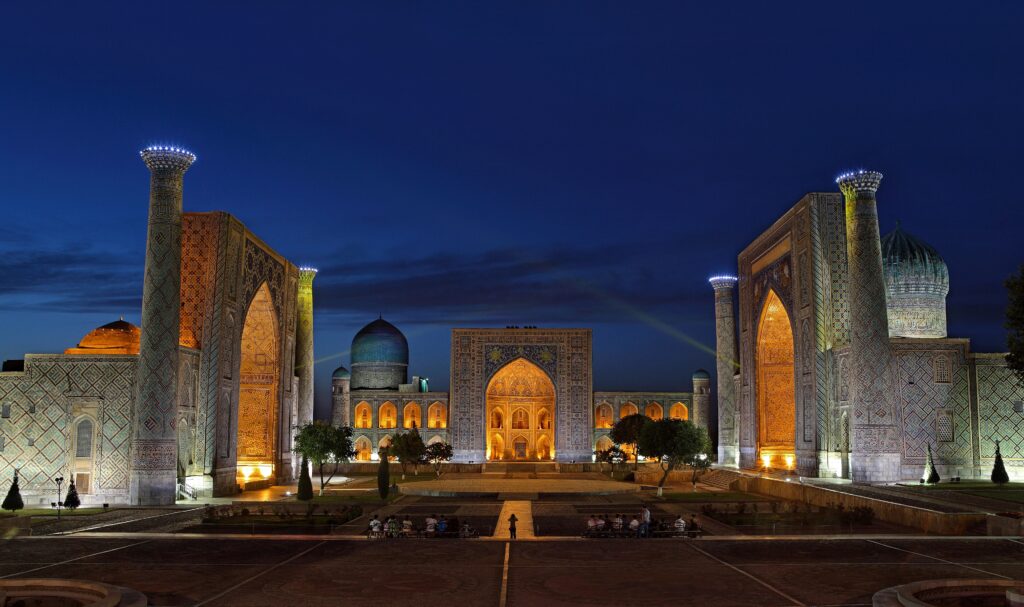
Samarkand. Timur made the city his capital in the fourteenth century. The Registan, a square enclosed by three tiled madrasas, is the image of Central Asia. Near it are the tomb of Timur, the avenue of mausoleums called Shah-i-Zinda and the remains of the observatory of his grandson Ulugh Beg. Allow two days.
Bukhara. The old town is smaller, lower and browner than Samarkand, and many travellers prefer it. Its mosques, madrasas, covered bazaars and merchants’ houses are all within walking distance, and several of the houses are small hotels. In 2025 the city held its first biennial in restored caravanserais. Allow two or three days.
Khiva. The walled town of the old khanate lies a further 450 kilometres to the north-west across the desert. Since May 2026 high-speed trains have run on from Bukhara to Urgench and Khiva, on an electrified line designed to cut a journey of six hours to about two. The service is new, and timetables should be checked when booking. There are also flights to Urgench.
Booking
The Afrosiyob is the one difficulty of the journey. There are only a few trains a day and they sell out weeks ahead in spring and autumn. Tickets are sold in advance through the railway’s website and app, and should be bought as soon as dates are fixed. If the fast train is full, the conventional Sharq service covers the same route in roughly twice the time.
When to go
April, May, September and October are the best months. Summer temperatures pass forty degrees, and winter is cold but clear and empty. Citizens of many countries can now enter without a visa. Elsewhere in Central Asia, Kazakhstan gained a major new museum in 2025 with the opening of the Almaty Museum of Arts. For other railways across the continent, see our guide to Asia by train.
Continue
More from Uzbekistan
 UzbekistanUzbekistanSamarkand, Bukhara and Khiva: the tiled madrasas and bazaars of the Silk Road.Read →News · CultureBukhara Holds Its First Biennial in Restored Caravanserais and MadrasasFrom 5 September to 20 November 2025 the old Silk Road city showed more than 70 commissions made…September 5, 2025Read →