Songtsam Lodge Cizhong
In a Tibetan Catholic village on the upper Mekong, where the missionaries' grape is still pressed at home, Songtsam has reopened its lodge as a working winery facing the church.
- Neighbourhood
- Cizhong village, Deqin County
- Status
- Open
- Design
- Qi Shanshan (Studio Qi)
From the windows of Songtsam Lodge Cizhong, the view runs across a vineyard to a church. Cizhong is a village on the Lancang, the upper Mekong, at about 2,200 metres in the deep valley where the Nushan and Biluo ranges meet, some 40 kilometres from the Myanmar border, and its Tibetan and Naxi families are mostly Catholic.

Their church was begun after 1905, when a rising against the missions burned ten churches along the Lancang and Nu rivers and killed two French priests; compensation from the Qing government paid for the new site, and the building was finished in 1921. It is a basilica of brick and timber with a bell tower under an upturned Chinese roof. It came through the Cultural Revolution because it was being used as the village school, and it has been a protected national monument since 2006.
The vines
The French priests planted vines as well, to make wine for the Mass. The grape most associated with them is Meiguimi, or Rose Honey, a red variety said to have disappeared from France; Cizhong households still grow it and press it into wine of their own. Outside investment has since followed: Moët Hennessy makes wine at its Ao Yun estate in the same region.
Songtsam's lodge joined that story only recently. The Tibetan hotel group, founded in 2000 by Baima Duoji, a former documentary filmmaker, had run a 10-room lodge in the village; it closed it for two years and reopened it in August 2025 with 26 rooms as its first winery hotel.
Songtsam's vineyards are planted at two heights, chosen for different grapes: around 1,900 metres at Riju, warm enough for Cabernet Sauvignon and Merlot to ripen late, and around 2,700 metres at Hongpo, cool enough for Chardonnay. The first wine released was a Chardonnay, made by the winemaker Quan Shiping from grapes picked by hand before dawn and fermented in new oak. Five young Tibetan women tend the vines without pesticides or sticky traps: insects are shaken off the trunks, one low plot is left unnetted for the birds, and walnut shells are used to feed the weaker plants.
The lodge
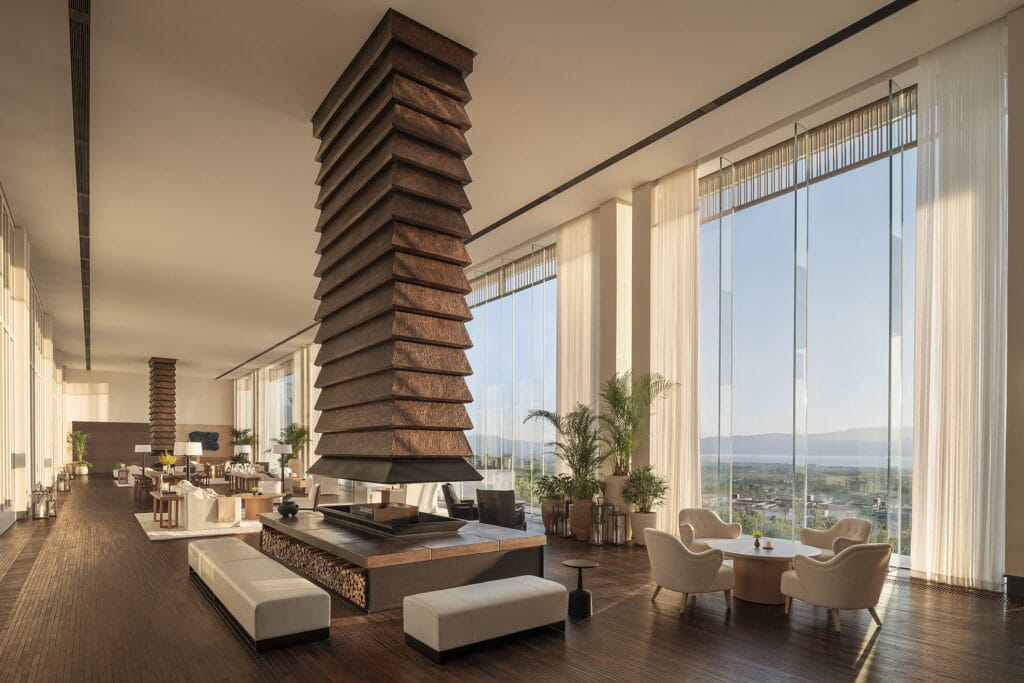
Qi Shanshan, who directs Songtsam's design and art centre, redesigned the interiors in salvaged timber, carved window frames, regionally made bronze furniture and high wooden wainscoting, in earth yellows and the purple of grapes, and hung black-and-white photographs taken by Western explorers in the first half of the twentieth century. Every room opens onto a balcony above the Lancang valley. The deluxe rooms, 44 to 52 square metres, are for two; families need one of the three family rooms, of 90 to 114 square metres.
The kitchen cooks from the valley, with butter tea, smoked and cured pipa pork, rice and vegetables in walnut oil, and in season matsutake served with a dry white; the lodge pours its own wines beside those of Ao Yun and Xiaoling Estate.
The lodge is one stage of the lodge-to-lodge journeys Songtsam runs across north-west Yunnan, set out in OKYTO's Yunnan lodge-to-lodge guide; its Nujiang Canyon lodge lies on the Salween, on the far side of the same mountains. At harvest, guests can go into the vineyard and pick with the villagers.