ExperienceHo Chi Minh City, Vietnam
Walk the temples and lanes of Cholon, Saigon’s Chinatown
Cantonese and Fujianese temples, a vast market and noodle stalls in Saigon's old Chinese town.
Cultural Immersion · Half a day · Easy
What the experience is
Cholon, the “big market”, grew in the eighteenth century as a separate Chinese trading town a few kilometres west of Saigon, settled by families who had left southern China after the fall of the Ming and by later waves of migrants. It merged with the city long ago, in what are now Districts 5 and 6, but it keeps its own character: the temples and assembly halls of the Cantonese, Fujianese, Teochew and Hakka communities, shophouses selling herbs, paper offerings and tea, a huge wholesale market and some of the best noodle stalls in Ho Chi Minh City. It is the part of the city that most visitors miss, and it is a short taxi ride from the centre.
What you see
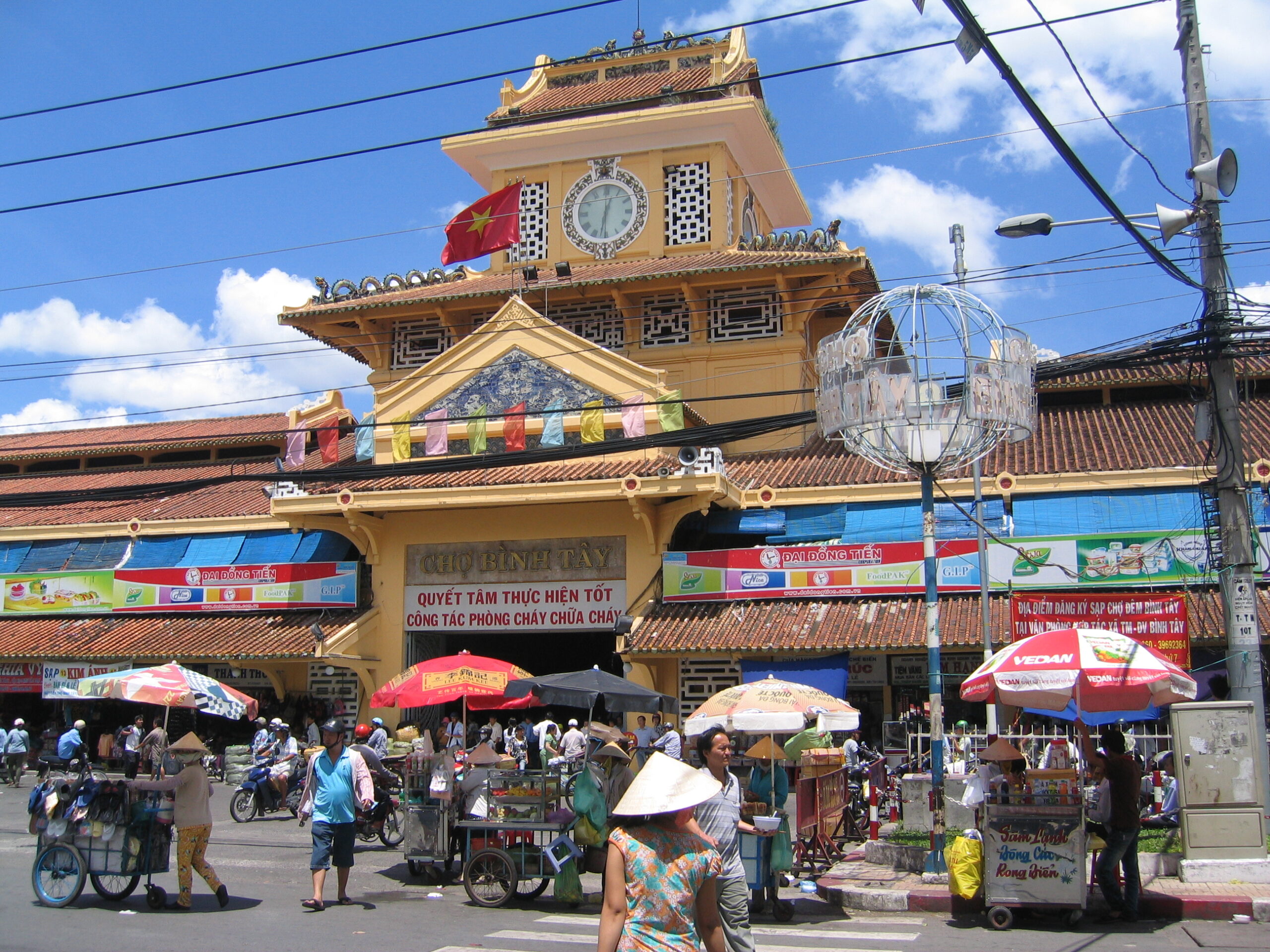
Begin at the Thien Hau Temple on Nguyen Trai Street, founded by the Cantonese community in the mid-eighteenth century and dedicated to the goddess of the sea who protected sailors and merchants. Its roof ridges carry crowded ceramic scenes of figures and buildings, and inside, giant incense coils hang from the ceiling, each bought by a family for a prayer. A few streets away, the Quan Am and Phuoc An Hoi Quan temples, built by the Fujianese, are smaller and quieter, with fine wood carving. To the west, the Binh Tay Market, under its clock tower, is the wholesale heart of Cholon, selling dried goods, ceramics, cloth and much else. Between them, the alleys hold the district’s everyday life: medicine shops, temple suppliers and noodle stalls.
When to go
In the morning, when the temples are busy with worshippers and the market is at its liveliest, and before the midday heat. The days around the Lunar New Year and the Lantern Festival bring crowds and ceremonies to the temples, and a very different atmosphere.
How to go
Cholon is ten to fifteen minutes by taxi from central Saigon. The main temples are close together and best seen on foot or by cyclo, starting at Thien Hau and working through the alleys. Allow at least half a day. Dress modestly for the temples, and ask before photographing worshippers. Some buildings in the district have been under renovation in recent years, including the Binh Tay Market, so check the current state before planning around a single site. For eating along the way, see OKYTO’s gastronomic guide to Ho Chi Minh City.
Why OKYTO recommends it
Cholon shows that Saigon was always a city of several communities, and that the Chinese merchant culture which built the old ports of the region, from Hoi An and George Town to Cholon, is still alive here. It makes a good counterpart to the French-colonial landmarks around Dong Khoi and Lam Son Square, where Park Hyatt Saigon faces the Opera House; Hotel des Arts Saigon, in the old District 3, is a convenient base between the two. For the delta beyond the city, see the Mekong Delta.
Sources: Rusty Compass, Cholon: Saigon’s Chinatown (2024); Culture Trip, Cholon: exploring Ho Chi Minh City’s Chinatown.
The Details
Essentials
- Location
- Thien Hau Temple, Nguyen Trai Street, District 5
- Duration
- Half a day
- Best time
- Year-round; mornings; Lunar New Year for festivities
Planning
- Level
- Easy
Continue
More experiences
 Cultural ImmersionHo Chi Minh CityWalk colonial Saigon from the Opera House to the cathedralThe Opera House, Dong Khoi, the Central Post Office and Notre-Dame cathedral in a morning on foot.