The Classical Gardens of Suzhou: Which to See and How to Look
Nine of Suzhou's scholar gardens are World Heritage sites. They are small, walled and intensely composed, and they reward a slow visit. A guide to choosing three and understanding what you see.
Suzhou lies half an hour west of Shanghai by high-speed train. For a thousand years it was one of the richest cities in China, a place of silk merchants, retired officials and painters, and they built gardens. In the late Ming and early Qing dynasties there were about two hundred. Sixty-nine survive, and UNESCO has listed nine, four in 1997 and five in 2000, as the most refined examples of the Chinese garden.
What a scholar garden is
These are not parks. They were private, attached to houses, and enclosed by high white walls. Their owners were men educated in poetry and painting, and a garden was a landscape painting in three dimensions, into which the owner could withdraw from public life.
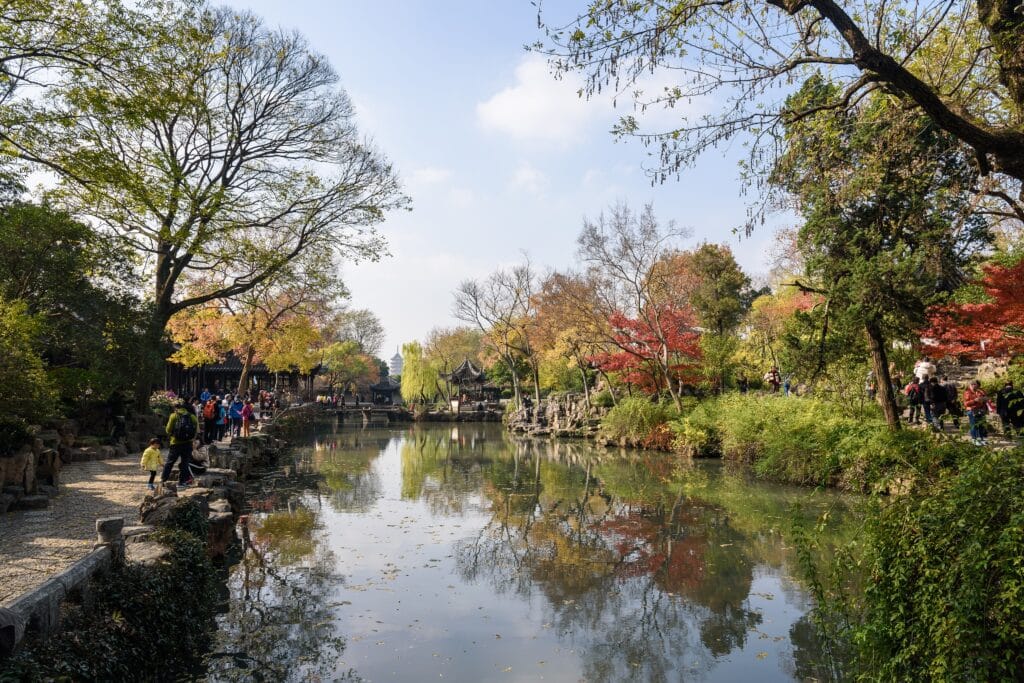
The elements are few. Water lies at the centre, usually an irregular pond. Rocks stand for mountains. The most prized are the pitted and hollowed limestones from Lake Tai, set up singly like sculpture or piled into artificial hills with caves and paths. Plants are chosen for their meaning as much as their look: bamboo for integrity, pine for endurance, lotus for purity, plum for courage in the cold. Halls, pavilions, covered walks and bridges are placed so that the visitor is led from one composed view to the next.
The art lies in making a small space seem large. A path bends so that the end cannot be seen. A wall hides a court and a window cut in the shape of a fan or a vase reveals a part of it. A distant pagoda outside the garden is drawn into the view, a device called borrowed scenery. Every hall and rock has a name taken from poetry, and the names are part of the garden.
Which to see
Three is the right number for a day. More become a blur.
The Humble Administrator’s Garden. The largest, at about five hectares, laid out in the early sixteenth century by a retired official. A third of it is water. It is the most famous and by far the most crowded. Go when the gates open.
The Master of the Nets Garden. The smallest of the great gardens, about half a hectare, and the most admired by specialists. Everything is arranged round a single square pond. A courtyard here was copied for the Metropolitan Museum in New York. On summer evenings, musicians perform in its pavilions.
The Lingering Garden. Known for its sequence of courts and corridors, and for a Lake Tai rock more than six metres high, the tallest in the city.
For a fourth, choose the Lion Grove, a maze of rockwork that once belonged to the family of the architect I. M. Pei, or the Great Wave Pavilion, the oldest, which dates from the eleventh century and opens on to a canal. The Couple’s Retreat is the quietest. One of the nine, the Retreat and Reflection Garden, is in the water town of Tongli, half an hour away.
How to look
Walk slowly, and stop where the path stops you. Sit in the pavilions, since the views were composed for seated people. Look through windows and doorways as frames. Notice the paving, which is laid in patterns of pebble and tile. Early morning, light rain and winter, when the structure shows, are the best conditions. The first week of May and of October should be avoided.
The rest of the city
The Suzhou Museum, beside the Humble Administrator’s Garden, was designed by I. M. Pei and opened in 2006. It is a modern garden in its own right. The old streets of Pingjiang Road follow a canal near it. On Jinji Lake, in the new city, the Suzhou Museum of Contemporary Art takes its plan from the garden corridor, and a Mandarin Oriental is planned on its shore. On Yangcheng Lake, Sangha Retreat offers a stay of a different kind.
Continue
More from Suzhou
 ChinaSuzhouChina's garden city: nine World Heritage scholar gardens, canal streets and I. M. Pei's museum.Read →
 News · TravelMandarin Oriental Plans Lakeside Hotel in SuzhouDeveloped with Hongkong Land and designed by ZNA.February 13, 2025Read →News · Design & ArchitectureSuzhou Museum of Contemporary Art Opens Under BIG’s Ribbon RoofThe 60,000 sq m museum on Jinji Lake, twelve pavilions under one continuous roof.September 3, 2026Read →News · TravelBanyan Tree Yangcheng Lake Announced Near Suzhou, With Private Hot Springs on Every TerraceBanyan Group announced Banyan Tree Yangcheng Lake in September 2024: 70 rooms and villas.September 12, 2024Read →