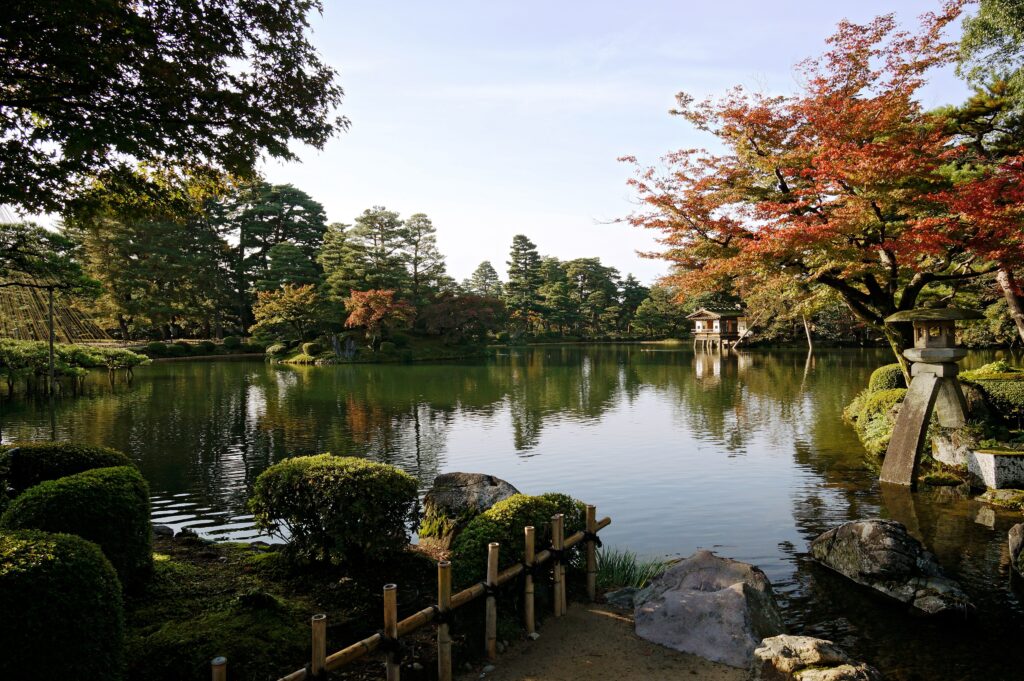
Kenrokuen and Old Kanazawa: The Garden, the Teahouses and the Samurai Quarter
Kenrokuen took the Maeda lords two centuries to make and is counted among the three great gardens of Japan. Around it, a city that escaped wartime bombing keeps its teahouse streets and samurai lanes. How to see them in a day or two.
Kanazawa was the seat of the Maeda family from 1583 until the end of feudal rule. Their domain was valued at one million koku of rice, the largest held by any lord under the Tokugawa shoguns, and they spent it on culture rather than on arms. The city was also among the few large Japanese cities spared by air raids in the Second World War. The result is a castle town whose garden, entertainment districts and samurai quarter are still in place, all within about two kilometres of the castle.
The garden of six attributes
Kenrokuen began as the outer garden of Kanazawa Castle. The fifth lord, Maeda Tsunanori, built a first garden here in 1676. Most of it burned in 1759. Restoration began in 1774, the twelfth lord added winding streams in 1822, and the garden had taken its present form by the 1840s. It was opened to the public on 7 May 1874.
The name, given in 1822, means “garden of six attributes”. It refers to a Chinese idea that a perfect landscape combines six qualities that normally exclude one another: spaciousness and seclusion, artifice and antiquity, water and wide views. Kenrokuen is ranked with Korakuen in Okayama and Kairakuen in Mito as one of the three great gardens of Japan.
It covers a little over eleven hectares on a hill, with some 8,750 trees. The water that feeds its ponds and streams has come from a distant river by a canal since 1632. Because the garden lies below the source, the water rises under its own pressure in a fountain about 3.5 metres high, said to be the oldest in Japan.
What to look for
The emblem of the garden is the Kotoji lantern, a stone lantern on two legs of unequal length that stands at the edge of Kasumigaike, the main pond. The Karasaki pine beside the pond was grown from seed brought from Lake Biwa. Yugao-tei, a teahouse of 1774, is the oldest building. A second teahouse, Shigure-tei, serves tea to visitors.
From November the gardeners raise poles above the pines and tie the branches to them with ropes that fan out in a cone. This is yukitsuri, a protection against the heavy, wet snow of the Sea of Japan coast, and it has become the winter image of the city. Plum blossom runs from mid-February to late March, cherry blossom comes around mid-April, and the maples turn from mid-November to early December.
The teahouse districts
Kanazawa has three preserved districts of chaya, the houses where guests are entertained by geisha with music and dance. In the Edo period such houses were confined to licensed quarters at the edge of the city. Higashi Chaya, east of the Asano River, is the largest. Its main street is lined with two-storey wooden houses with fine lattice fronts.
Two of the houses admit visitors. Shima has been kept as a museum, with its performance rooms, kitchen and musical instruments in place. Kaikaro still works as a teahouse in the evenings and opens by day, with tea served. Other houses are now cafes and craft shops, among them a gold-leaf shop whose old storehouse is covered in gold inside and out. Kazuemachi, along the river, and Nishi Chaya, across the city, are smaller and quieter.
Nagamachi and the market
Nagamachi, west of the castle, was a district of samurai residences. Its lanes run between ochre earthen walls, with water channels alongside. Omicho Market, between the station and the castle, has operated since the Edo period and is mostly given over to seafood from the Sea of Japan.
For travellers
Kenrokuen is open every day. It admits visitors free of charge in the early morning, before the regular opening time, and that is the hour to go: the tour groups have not arrived and the light is low on the pond. The city’s loop bus reaches the garden from the station in about twenty minutes and Higashi Chaya in about fifteen.
A sensible day starts in the garden at dawn, continues to the 21st Century Museum and the D.T. Suzuki Museum, both within ten minutes’ walk, and ends in Higashi Chaya in the late afternoon. The gold leaf seen there is explained in our guide to Kanazawa’s crafts. Kanazawa is about two and a half hours from Tokyo by the Hokuriku Shinkansen.