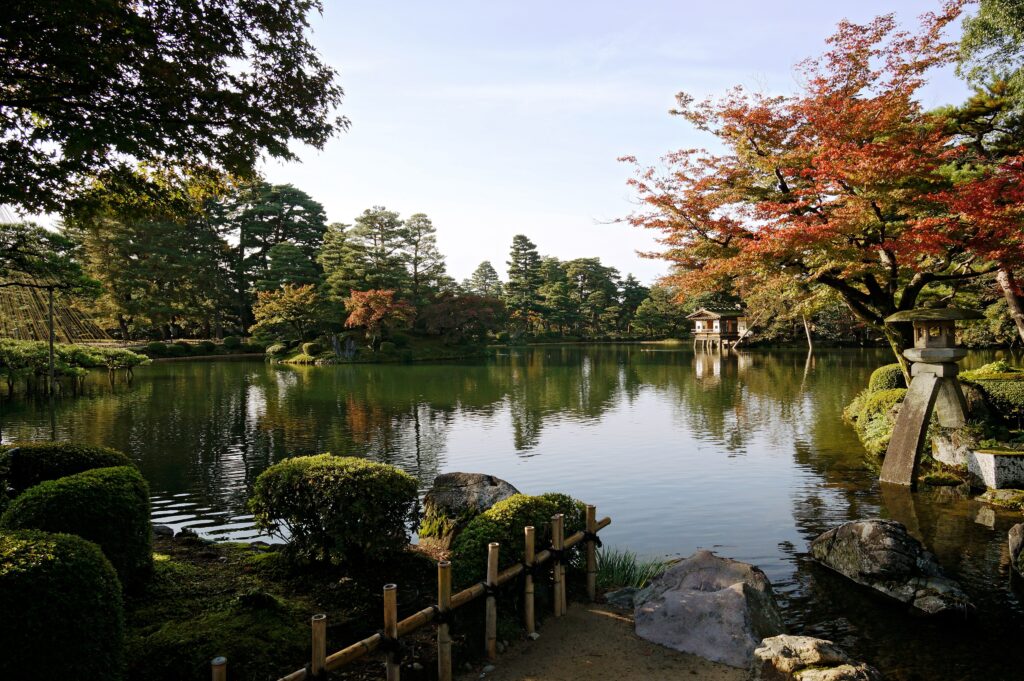
The D.T. Suzuki Museum: Taniguchi’s Water Garden for a Zen Thinker
In the district of Kanazawa where Daisetz Suzuki was born, Yoshio Taniguchi built three small pavilions around a sheet of still water. The museum explains very little and is one of the quietest buildings in Japan.
The D.T. Suzuki Museum opened in Kanazawa in October 2011. It stands in Honda-machi, the district where its subject was born, ten minutes’ walk from Kenrokuen. It is a small building, with a floor area of about 630 square metres, and most visitors spend longer looking at water than at exhibits. That is the intention.
Who Suzuki was
Daisetz Teitaro Suzuki was born in Kanazawa on 18 October 1870. As a student he practised Zen at Engaku-ji in Kamakura under the abbot Soyen Shaku, who gave him the name Daisetsu. Soyen introduced him to the American publisher Paul Carus, and from about 1897 Suzuki lived for more than a decade in Illinois, translating Buddhist and Chinese texts into English.
He returned to Japan, married the American Beatrice Lane in 1911, and from 1921 taught at Otani University in Kyoto, where the couple founded the Eastern Buddhist Society. His Essays in Zen Buddhism, published in 1927, was the book through which much of the English-speaking world first met Zen. In 1949, at the age of 79, he went back to the United States, and from 1952 to 1957 he lectured at Columbia University in New York. Zen and Japanese Culture appeared in 1959. He died in Kamakura on 12 July 1966, aged 95.
Three wings, three gardens
The architect is Yoshio Taniguchi, who also designed the Gallery of Horyuji Treasures at the Tokyo National Museum and the Heisei Chishinkan wing of the Kyoto National Museum. His building in Kanazawa has three parts joined by corridors: an Entrance Wing, an Exhibition Space Wing and a Contemplative Space Wing. Each has a garden: the Vestibule Garden, the Roji Garden and the Water Mirror Garden.
The visitor is led along a long, dim interior corridor to the exhibition room, where a few manuscripts, photographs and books are shown with short texts. A second room is for reading. Then the route turns outside, along the edge of the Water Mirror Garden: a wide, shallow, rectangular pool bounded by plain walls, with the trees of the hillside behind.
The Contemplative Space stands in the pool. It is a single square room, white outside, with a large opening in each of its four walls and benches inside. There is nothing in it. People sit and look at the water, which is disturbed at intervals by a mechanism that sends a single ring of ripples across the surface.
Why it works
Museums devoted to writers usually fail, because a life of thinking leaves little to display. Taniguchi’s answer is to make the building do what the books describe. The sequence from dark corridor to open water is a simple piece of staging, and the proportions of walls, pool and sky are exact. It takes twenty minutes to walk through and rewards an hour.
For travellers
The museum is open from 9.30 to 17.00, with last entry at 16.30. It is closed on Mondays, or the following day when Monday is a holiday, during changes of exhibition and from 29 December to 3 January. The nearest stop on the Kanazawa loop bus is Honda-machi, about five minutes away on foot; there is no car park. A path through the trees behind the museum leads up towards the prefectural museums and Kenrokuen.
Go early or late in the day, when it is least busy, and on a still day if possible. It pairs well with the 21st Century Museum, which is close by and entirely different in temper. Travellers who want to practise rather than read can continue by shinkansen to Fukui for Eiheiji, the Zen training monastery where guests may sit zazen.