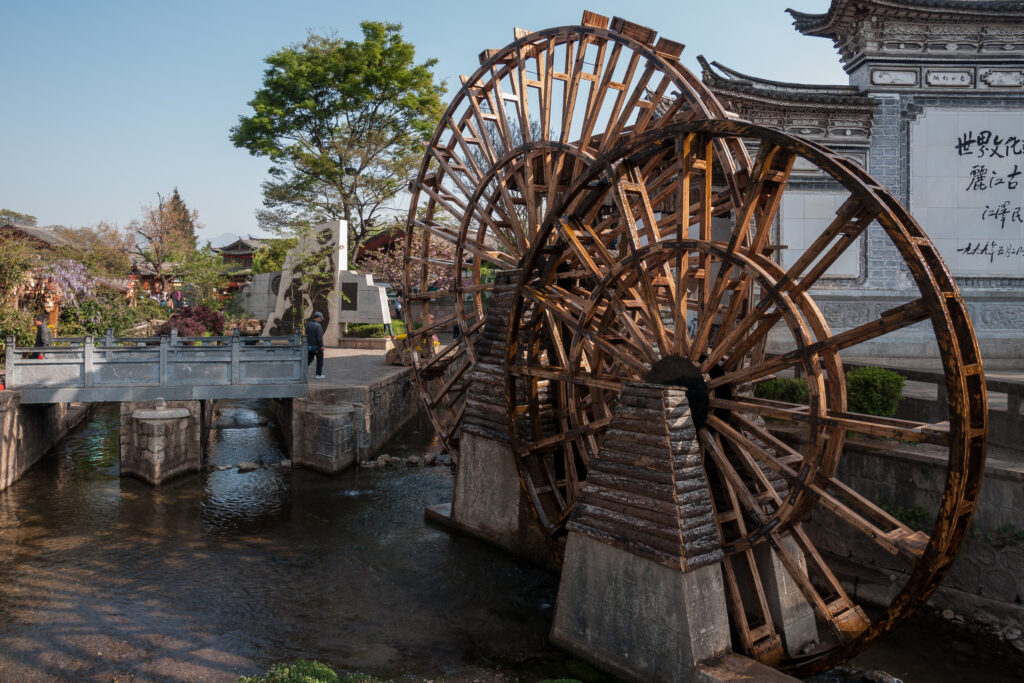
The Old Town of Lijiang: What Remains Behind the Crowds
The Naxi town of canals and timber houses below Jade Dragon Snow Mountain has been a World Heritage site since 1997. It is now very busy. The two villages listed with it are the better part of a visit.
Lijiang stands in the north-west of Yunnan, on a plateau at about 2,400 metres below the Jade Dragon Snow Mountain. Its old town, Dayan, has a history of many centuries. It grew as a market on the Tea Horse Road, the caravan route that carried tea from southern Yunnan to Tibet, and it is the chief town of the Naxi people. UNESCO inscribed it on the World Heritage List on 4 December 1997, together with two nearby villages, Baisha and Shuhe.
A town of water
The old town has no walls. Its plan is given by water. Streams from the Black Dragon Pool, at the northern edge, divide into channels that run beside and beneath the lanes, crossed by small stone and timber bridges. The system of waterways and bridges is what the town is known for.
The houses are of timber and mud brick, with tiled roofs, built around courtyards. At the centre is the Mu Mansion, the residence of the hereditary rulers of Lijiang.
Earthquake and listing
In February 1996, less than two years before the World Heritage listing, a severe earthquake struck the region. Many buildings had to be reconstructed. The timber-framed houses of the old town were rebuilt in the traditional manner, and the work drew national attention to the place.
What tourism changed
The listing brought visitors in very large numbers. Rents rose, and many of the original inhabitants moved out; accounts differ on the proportion. Much of the residential land has become guesthouses, shops and restaurants. The water system came under strain and has since been restored by the authorities.
A visitor should know this in advance. The main lanes of Dayan are a busy commercial district, lively at night. The fabric of the town, its roofs, bridges and channels, is largely intact and worth seeing. The life that made it is found elsewhere.
Baisha and Shuhe
The two villages listed with the old town lie a few kilometres to the north. Shuhe was a staging post on the Tea Horse Road and has a similar pattern of streams and squares on a smaller scale. Baisha, further on, is generally described as an earlier centre of Naxi rule and is the quietest of the three, with the snow mountain directly behind it.
Naxi culture survives most visibly in music and ritual. Orchestras of elderly musicians perform Dongjing music, which is said to preserve an old repertoire of Chinese court and temple music. In the squares, residents gather to dance in a circle in local dress.
For travellers
Walk the old town early in the morning, before the shops open, when the lanes are empty and the water is clear. Climb to a viewpoint for the sea of grey roofs with the mountain beyond. Then spend the afternoon in Shuhe or Baisha. The altitude is about 2,400 metres, and the sun is strong.
The best place to stay near the old town is described in our article on Amandayan. From Lijiang, travellers continue to Tiger Leaping Gorge and, by the railway opened in 2023, to Shangri-La.
Continue