Kamalaya Koh Samui
On the south coast of Koh Samui, Kamalaya grew from an old monks' cave that John Stewart found in 2000: a wellness resort built as a hillside village around boulders, trees and the cave itself.
- Neighbourhood
- Laem Set, south coast of Koh Samui
- Rooms
- 76
- Opened
- November 2005
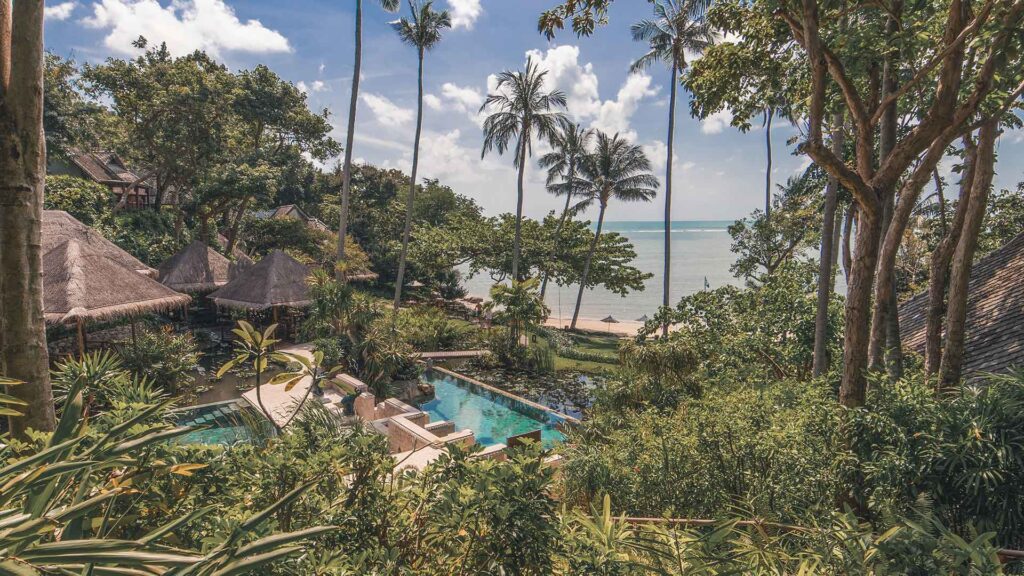
Photo: Kamalaya Koh Samui
Kamalaya is Sanskrit for lotus realm, kamala and alaya. The resort's story, as its founders tell it, begins in 2000, when John Stewart, a Canadian who had spent twenty-three years in the Himalayas, was recovering from an illness on Koh Samui and came across an old cave in densely forested land above the beach on the south coast. "I knew this was the place and so I called Karina to tell her." He had met Karina at a meditation retreat in the Himalayas in 1982; she had studied cultural anthropology at Princeton and trained in Traditional Chinese Medicine, and she designed the programmes. Kamalaya opened in November 2005.
In 2004 Robert Powell, whom Kamalaya describes as an Australian architectural artist, was given the brief to preserve the integrity of the land. With the landscape architect Victor Choong, who has been there from the start and also worked as its gardener, he drew on the communal building of old Nepal and Thailand and set the resort on the slope like a village, in humble natural materials, shaping each building around the existing boulders and trees; more than 150 trees were moved during construction, and some rooms take a boulder inside.
Yantra Hall and the Great Lawn are aligned with the path of the sun and moon along the coast, water rises near Yantra Hall and follows the ground down, and a 500-metre Pilgrim's Trail runs from Ganesh past spirit houses to a Maitreya Buddha. "In Taoism, nature is the primary healer," Karina Stewart said.
Today there are 76 rooms, suites and villas, from hillside rooms to villas on granite boulders above the sea, about twenty programmes that combine Eastern healing traditions with Western medical research, and a Longevity House with hyperbaric oxygen; OKYTO's guide to Thailand's three great wellness retreats compares it with Chiva-Som in Hua Hin and RAKxa outside Bangkok. The Stewarts began selling in 2021 to Christopher Harborne, a British investor who had come as a guest and uses the Thai name Chakrit Sakunkrit, and left altogether in 2024; OKYTO's article on Kamalaya's twenty years follows that story.
The cave is still at the centre, and the resort is laid out around it. Its entrance is hidden between granite boulders and covered in roots, and you bow beneath a giant tree to go in, standing up only once inside; "It's like going into a womb," John Stewart said. Monks used it for silent retreats for around three hundred years, the founders say. Two images of monks who lived there are on its walls, so blackened by smoke they are hard to make out, and the stone altar holds coins, jasmine, marigolds, incense and small wooden galleons, for the island's seafaring past. It is always open to guests.
Sources: Kamalaya; Kamalaya; Kamalaya; Kamalaya; Kamalaya; Spafinder; Global Wellness Institute; National Geographic Traveller; Spa Business; Kamalaya Koh Samui
Location
- Address
- 102/9 Moo 3, Laem Set Road, Na-Muang, Koh Samui, Surat Thani 84140, Thailand
- Website
- Official website
- Reservations
- Check availability
