Hotel Indonesia: The 1962 Landmark That Introduced Jakarta to the World
Built for the Asian Games of 1962, the first international hotel in Indonesia gave its name to the roundabout at the centre of the capital. It was restored and reopened in 2009.
The roundabout at the centre of Jakarta, where the main avenue of the city widens around a fountain, is called Bundaran HI. The letters stand for Hotel Indonesia. The hotel on its western side has been a landmark of the capital since 1962, and its history is tied to that of the country.
Built for the Games
In 1962 Jakarta was host to the fourth Asian Games. Indonesia had been independent for little more than a decade, and President Sukarno intended the occasion to present a modern nation to the world. He ordered a stadium, a broad new avenue, a department store and a hotel of international standard, which the city did not have.
The hotel was designed by the American architect Abel Sorensen and his wife, Wendy Becker. It was a pair of slabs in the International Style, raised on columns, with deep balconies and sun screens suited to the climate. It opened on 5 August 1962 and was the first five-star hotel in Indonesia and one of the first in Southeast Asia.
In front of it, in the middle of the roundabout, Sukarno had a monument set up to greet the athletes arriving from the airport: a bronze of a young man and woman on a tall plinth, waving, the woman holding flowers. It is called Selamat Datang, meaning welcome. It is still the emblem of the city.
The art
Sukarno was a collector and took a close interest in the decoration. The hotel was given works by the leading Indonesian artists of the time, including large stone reliefs of the life of the islands, mosaics and paintings, in a spirit of national pride. Several remain in the public rooms.
The centre of things
In the 1960s and 1970s the hotel was the place where Jakarta society met. Its stage and its supper club, the Nirwana, launched the careers of many Indonesian singers and entertainers, and its swimming pool and coffee shop were the first that many residents had seen. Foreign correspondents made it their base.
By the 1990s newer hotels had overtaken it. In 1993 the governor of Jakarta declared it a cultural heritage site, which protected the building and its contents.
The restoration
The hotel closed in 2004. The land behind and beside it was developed as Grand Indonesia, a large shopping centre with office and apartment towers. The two original wings were kept and restored, and reopened on 20 May 2009 as Hotel Indonesia Kempinski. The number of rooms was reduced from 406 to 289 to make them larger. The wings are named Ramayana and Ganesha. The facades, the lobby reliefs and the Bali Room, the old ballroom, were preserved.
For visitors
The hotel remains one of the best placed in Jakarta. The roundabout has a station on the city’s metro, which opened in 2019, and on Sunday mornings the avenue is closed to cars and filled with walkers and cyclists. The rooms on the roundabout side look directly at the monument.
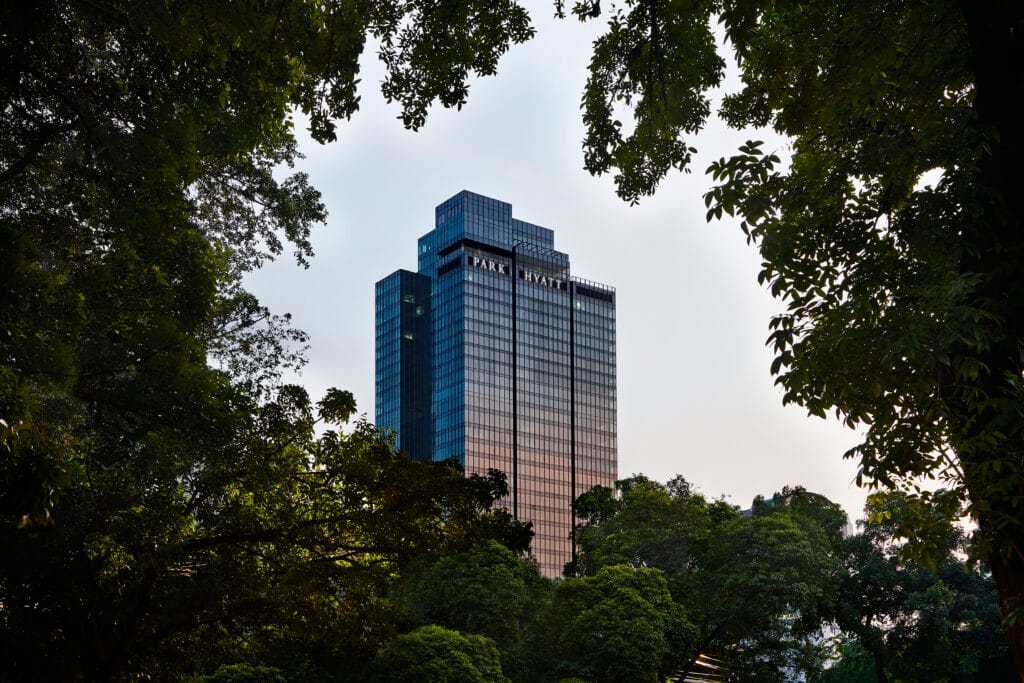
Jakarta’s other hotels of note are more recent. Raffles Jakarta is built around the work of the painter Hendra Gunawan, Park Hyatt Jakarta occupies the top of a tower in Menteng, and The Langham is in the business district to the south. For a short journey out of the city, the Whoosh high-speed train reaches Bandung in under an hour.
Continue
More from Jakarta
 IndonesiaJakartaIndonesia's sprawling capital, where Dutch colonial heritage.Read →News · TravelPark Hyatt Jakarta Opens at the Top of a Tower in MentengIndonesia's first Park Hyatt opened in mid-2022 with 220 rooms on the top 17 floors of a 37-storey tower.July 10, 2022Read →News · TravelWhoosh, Southeast Asia’s First High-Speed Train, Links Jakarta and BandungCommercial service began on 17 October 2023 on a 142-kilometre line run at up to 350 km/h. The journey between…October 17, 2023Read →News · TravelThe Langham, Jakarta Opens in SCBDLangham Hospitality Group's first Southeast Asian hotel brings Tom Aikens.September 9, 2021Read →