Jaipur’s Walled City Joins the World Heritage List
UNESCO inscribed the walled city of Jaipur on 6 July 2019. Founded in 1727 on a grid plan, the capital of Rajasthan is one of the earliest planned cities of modern India.
The walled city of Jaipur was added to the UNESCO World Heritage List on 6 July 2019. The capital of Rajasthan was recognised under three cultural criteria, for its town planning, its architecture and its living traditions of craft and trade.
A city drawn on a grid
Jaipur was founded on 18 November 1727 by Sawai Jai Singh II, the Kachhwaha Rajput ruler of Amer, who moved his capital down from the hill fort to the plain. The plan is attributed to Vidyadhar Bhattacharya. Unlike the older cities of the region, which grew along the contours of their hills, Jaipur was laid out in advance. It follows the principles of the traditional Indian treatises on building, Vastu Shastra and Shilpa Shastra, and is divided into nine blocks. Broad streets 34 metres wide cut the city into sectors, and the ramparts are pierced by seven gates.
The main streets are lined with continuous rows of shops behind colonnades, built to a uniform design, with markets at the crossings. The palace of the ruler occupies the central blocks. This combination of a regular plan, a commercial purpose and a single architectural treatment is what makes the city one of the earliest planned cities of modern India.
Why it is pink
The colour came later. In 1876, during the reign of Sawai Ram Singh II, the city was painted pink to welcome Albert Edward, Prince of Wales. Many of the avenues are still painted in that colour, a terracotta closer to the tone of sandstone than to rose, and it has given Jaipur its familiar name, the Pink City.
What stands within the walls
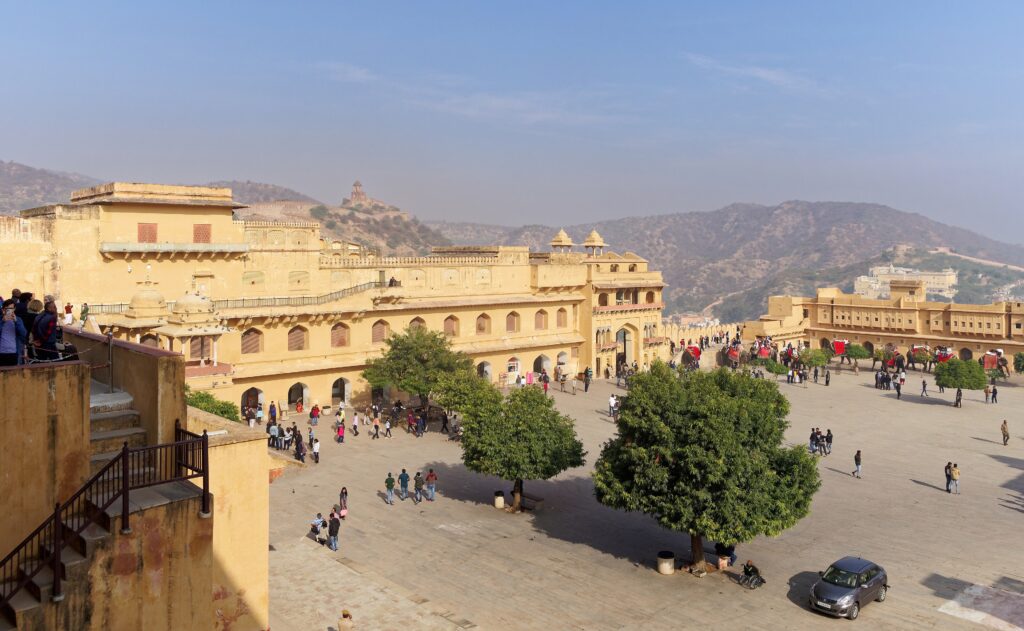
The City Palace, at the centre of the plan, is still partly occupied by the former ruling family. Beside it is the Hawa Mahal, a five-storey screen of 953 small windows, 15 metres high, built so that the women of the court could watch the street unseen. The Jantar Mantar, Jai Singh’s observatory of monumental masonry instruments, is next to the palace and has been a World Heritage site in its own right since 2010. Amer Fort, the earlier capital on the hill to the north, was listed in 2013 among the hill forts of Rajasthan.
The bazaars remain in use for the trades they were built for. Jaipur is a centre of gem cutting, jewellery, block-printed textiles and blue pottery, and whole streets are still given over to a single craft.
For travellers
Jaipur is 268 kilometres from Delhi and has an international airport 13 kilometres south of the centre, at Sanganer. The cool months from October to March are the season. The walled city is best explored on foot early in the morning, before the traffic builds, beginning at the Hawa Mahal and the palace and continuing through the bazaars.
The city is a stop on the luxury trains that cross the state, among them the Maharajas’ Express.