Hoi An: A Guide to Vietnam’s Old Merchant Port
For four centuries Hoi An was a port where Chinese, Japanese and European traders met. Then the river silted up and the trade left, and the town was preserved by neglect. More than a thousand of its old houses still stand.
Hoi An stands on the Thu Bon river, 28 kilometres south of Da Nang on the central coast of Vietnam. From the fifteenth to the nineteenth century it was one of the busiest ports of Southeast Asia. UNESCO listed the old town in 1999 as an exceptionally well-preserved example of a trading port of that period.
A port and its decline
The region belonged to the kingdom of Champa from the second century. Vietnamese settlers arrived in the late fifteenth century, and from the early seventeenth century Chinese and Japanese merchants came in numbers and built their own quarters. Ships waited here for the monsoon to turn, and the town dealt in silk, ceramics, spices and sugar.
In the nineteenth century the river mouth silted up and the trade moved to Da Nang. Hoi An stagnated, and little was pulled down because there was no reason to build anything new. The old town today has some 1,360 listed monuments and sites, of which more than a thousand are timber houses, on a grid of a few streets parallel to the river.
What to see
The Japanese covered bridge. A wooden bridge built at the start of the seventeenth century, with a small temple on one side. It is the emblem of the town.
The assembly halls. The Chinese merchants were organised by their province of origin, and each community built a hall for meetings and worship. Five survive, with courtyards, altars and elaborate gateways.
The merchant houses. Long, narrow houses of dark timber run from the street to the river, with a shop at the front, a courtyard in the middle and a warehouse at the back. Several have been lived in by the same family for generations and are open to visitors.
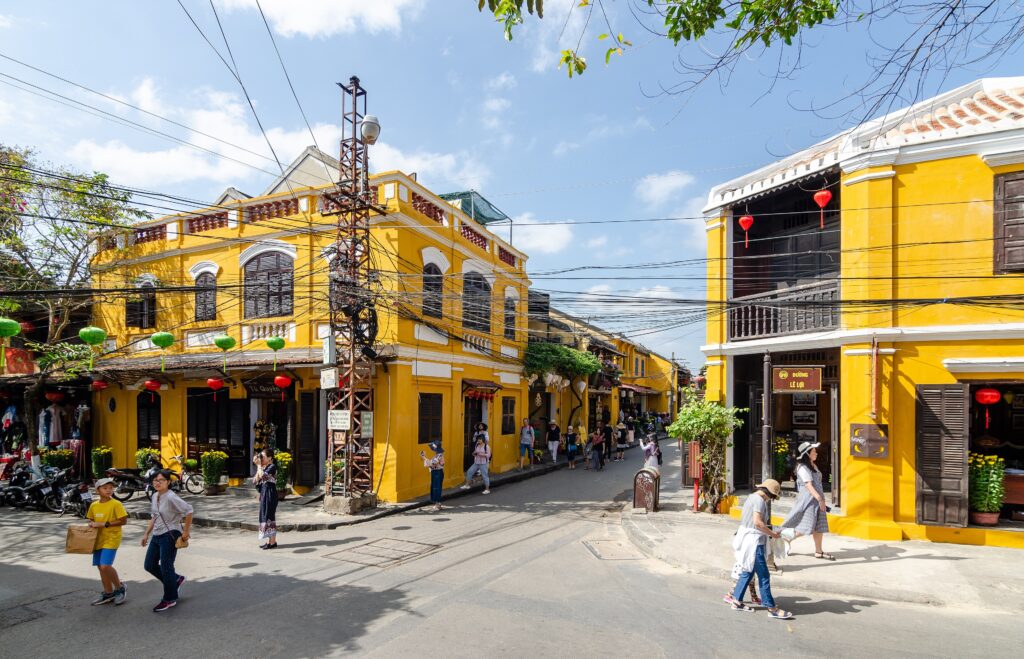
The streets themselves. The ochre walls, the tiled roofs and the silk lanterns hung across the lanes are the real attraction. The old town is largely given over to pedestrians and cyclists, with motor vehicles restricted during set hours of the day and evening, and it is at its best early in the morning and after dark, when the lanterns are lit.
Tailors and lanterns
Hoi An traded in cloth for centuries and is now known for its tailors, who make clothes to measure in a day or two. Quality varies with the price and the time allowed. Two fittings give a better result than one, so the order is best placed on the first day of a stay. Lantern makers and leather workers have shops in the same streets.
What to eat
The town’s own dish is cao lau: thick, chewy noodles with slices of pork, fresh greens and herbs, crisp squares of fried dough and only a spoonful of broth. The noodles are made from rice soaked in lye water, which gives them their colour and texture. Tradition holds that the water must come from one old well in the town and the ash from trees on the Cham Islands offshore, and the dish is rarely found elsewhere.
For travellers
Two or three days are enough for the town, with time for the beach, which is a short ride away. The streets can be walked freely, but a ticket is needed to enter the monuments, which admits the holder to a choice of houses, halls and museums; the current rules should be checked on arrival. The pleasant months run from February to May. Summer is hot, and in the autumn rains the river often floods the lower streets.
Da Nang airport is about 30 to 45 minutes away. Four Seasons Resort The Nam Hai is on the beach fifteen minutes from the old town. Our walk through the old town sets out a day on foot. Most travellers pair Hoi An with the imperial city of Hue, to the north, and the railway from Da Nang carries The Vietage south along the coast.
Continue